
Editor’s Note: Silencing does not always take the form of direct confrontation. Sometimes a leader stops inviting the person who asks the inconvenient question, and that difference can decide what the decision costs. Dropping a name from a distribution list may leave no contemporaneous explanation, and can leave the affected person without a clear decision to challenge, which makes it cheaper for everyone except the person absorbing it.
For professionals in cybersecurity, information governance, regulatory compliance and eDiscovery, the pattern is operational rather than cultural. The questions that get people sidelined at a launch meeting are the ones that surface later under oath: who owns a model’s output, whether a pilot’s prompts and responses are records, what the retention schedule covers. Research on organizational silence, psychological safety and ostracism helps explain why those questions go unasked. The Challenger record shows what happens when an objection stops being visible inside the decision it was meant to inform.
Watch the invitation list as well as the decision log. Survey data already places lower psychological safety and greater doubt about new technology in the same respondent group. A roster that shrinks between meetings is worth reviewing, particularly when the decision log explains nothing.
News Analysis – Leadership Beat
From excitement to exclusion: what happens when leaders drop the questioner
ComplexDiscovery Staff
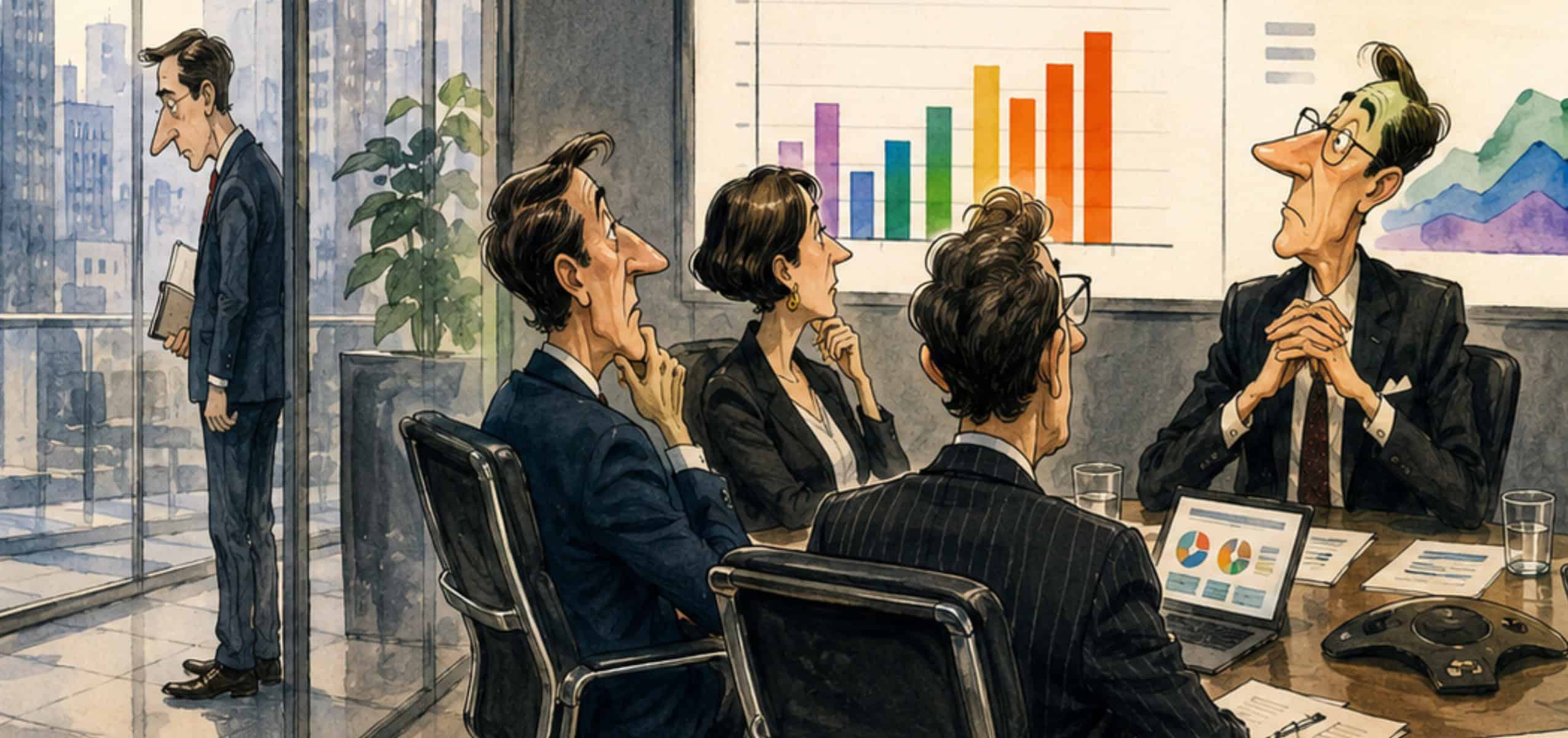
The initiative had a name, a budget and a room of nodding executives. Then someone asked what happens to the data in year three.
By the next meeting, that person was not on the invitation list.
That meeting is a composite. The sequence in it is not: excitement, a question, then exclusion. Nobody announces the removal. There is no conversation, no performance note, no moment anyone can point to afterward. An invite goes out with one fewer name on it, and the work resumes at a more comfortable pace.
Leaders may treat the question as a tone problem. It behaves more like a scheduling problem, and the argument here is that the last step quietly sets what a project costs.
Exclusion works because it is deniable
An overt reprimand creates an incident. Quietly dropping a name from the next invitation may leave no contemporaneous explanation. The invitation history can still surface later as a record, which is not the same thing as a reason. Workers appear to grade the two acts differently.
In a 2015 Organization Science article, Jane O’Reilly of the University of Ottawa, Sandra Robinson of the University of British Columbia, Jennifer Berdahl of the University of Toronto and Sara Banki of Sharif University of Technology compared workplace ostracism with harassment across three field studies. In the first, a wide range of employees judged ostracism, set against harassment, to be, in the authors’ words, “more socially acceptable, less psychologically harmful, and less likely to be prohibited in their organization.” In the second, across employees drawn from a variety of organizations, ostracism tracked more closely than harassment with a weakened sense of belonging and with lower scores on well-being and work-related attitudes.
The third study is the one to sit with. Inside one large organization, ostracism predicted actual turnover three years after it was assessed. Harassment did not. The authors traced that effect to a diminished sense of belonging, on evidence they themselves flagged as weaker than the turnover finding.
“There are many people who feel quietly victimized in their daily lives, and most of our current strategies for dealing with workplace injustice don’t give them a voice,” Sandra Robinson, one of the study’s authors, said in her university’s announcement of it.
What silence buys a leader, and for how long
The purchase is real, and it is short. Meetings run on time. The deck lands without amendment. Consensus arrives on schedule, and it looks exactly like alignment.
Elizabeth Morrison and Frances Milliken called the collective version of this organizational silence in a 2000 Academy of Management Review paper, arguing that when most members withhold their views, silence becomes shared behavior rather than individual choice. They traced it to an organization’s structures and policies and to its managerial practices. People go quiet, they argued, once they believe both that speaking carries a penalty and that it changes nothing.
Amy Edmondson of Harvard Business School had mapped the opposite condition a year earlier in Administrative Science Quarterly, studying 51 teams inside one manufacturing company and finding that psychological safety predicted learning behavior, which carried through to performance. One company is one company, and the study’s reach is bounded accordingly. “They know they can ask questions when they are unsure about something,” Edmondson said of psychologically safe workplaces, in a statement published with the American Psychological Association’s 2024 Work in America report.
APA’s 2025 survey found a perception gap inside organizations. Fielded by The Harris Poll among over 2,000 working adults in late March and early April 2025, the survey showed that upper management often viewed organizational change positively, while, in APA’s words, “frontline workers and individual contributors were frequently less optimistic.” APA recommended that employers gather and act on feedback broadly enough that decisions reflect the whole workforce.
A leader who removes the awkward voice is not lying when they report the room is aligned. They have built a room where alignment is the only available reading.
The question returns, and it costs more
The investigation into the 1986 Challenger space shuttle disaster documents the back half of that pattern, down to sworn testimony about the moment an objection was set aside.
The Rogers Commission concluded in 1986 that the launch decision was flawed, and explained why in terms that read like a governance finding. Those who made the decision, the commission wrote, “were unaware of the initial written recommendation of the contractor advising against the launch at temperatures below 53 degrees Fahrenheit and the continuing opposition of the engineers at Thiokol after the management reversed its position.”
The relevant mechanism was subtraction from the final decision process. Morton Thiokol engineers Roger Boisjoly and Arnold Thompson argued against launching. Boisjoly testified that Jerry Mason, the senior vice president for Wasatch operations, then asked Bob Lund, the vice president of engineering, to “take off his engineering hat and put on his management hat.” What followed is the line every committee chair should read twice: “I was not even asked to participate in giving any input to the final decision charts.” Of the rationale that went up the chain, Boisjoly added, “I was never asked nor polled, and it was clearly a management decision from that point.”
Boisjoly drew the distinction that matters. He told the commission he had had his say, and did not contest management’s right to weigh an engineer’s input and then decide against it. His grievance was narrower: after stating his opposition, he was not asked to help prepare the final decision charts, and he was not polled on the rationale that moved up the chain. Management kept the authority to decide. The technical objection stopped being visible inside the decision it was meant to inform.
Translate that into decisions a general counsel, a compliance officer or a security lead faces monthly. Who owns the model’s output. Whether a pilot’s prompts and responses are records. What the retention schedule says about a system nobody classified. Whether last quarter’s risk acceptance was written down anywhere. Each is unwelcome in a launch meeting and routine later, in a deposition, a regulator’s request, or an argument about what should have been preserved.
The question does not leave when the questioner does.
The 2024 APA survey suggests where that friction already sits. Workers reporting lower psychological safety were likelier to worry that artificial intelligence would render their job duties obsolete, in part or entirely, and less likely to say technology advances helped them work efficiently. The survey captured one moment and does not establish that either condition produced the other. It places lower psychological safety and concern about technological change in the same respondent group.
Assigned skeptics do not do the same work
One familiar remedy is to appoint one, so it is worth knowing what the experiments show.
Charlan Nemeth of the University of California, Berkeley, has spent a career testing what dissent does to group cognition. In mock-jury experiments summarized in a 2010 working paper for Berkeley’s Institute for Research on Labor and Employment, groups of four deliberated a personal injury case. Groups given an assigned devil’s advocate tended to generate thoughts reinforcing the position they already held, while authentic dissent produced divergent thinking and ideas on both sides. Dissent improves a group’s thinking, Nemeth has argued, even when the dissenting position turns out to be wrong, because the value lies in the search it forces rather than the answer it supplies.
A devil’s-advocate role filled by someone who substantially agrees with the plan may not reproduce the effect of authentic dissent, and the person who already asked the uncomfortable question cannot be replaced by assigning the role to somebody more agreeable. The experiments behind that were four-person juries, not governance committees, so take it as a caution rather than a measurement of how review boards behave. It is still the right caution.
Someone carries a cost no one records
Being cut out of a decision for asking about it can deliver a message with no sender: no meeting to request, no finding to appeal, no manager who will confirm anything occurred. The excluded person is left to litigate their own perception, alone, usually while still doing the job. Ambiguity is what makes exclusion cheaper than confrontation for everyone except the person absorbing it.
Adjacent data puts a number on a related penalty. The Ethics and Compliance Initiative’s 2023 Global Business Ethics Survey, drawn from 75,495 employee responses across 42 countries collected between August 2022 and January 2023, found that 46 percent of employees globally who reported observed misconduct perceived retaliation afterward. Reporting observed misconduct is a narrower act than questioning a technology plan, so the figure measures something adjacent to this article’s subject rather than the thing itself. It still shows the shape of the risk employees price before they speak.
APA’s 2024 report, fielded by The Harris Poll among over 2,000 employed adults from March 25 to April 3, 2024, suggests the effect travels. Fifteen percent of workers said their workplace is toxic, and 89 percent of that group also reported lower psychological safety at work. Exclusion may not stay with the excluded. Colleagues watch it happen, and what they are willing to ask next can change.
Where the line sits, and what to do
None of this makes every exclusion wrong. Working groups get too large to decide anything, and some people relitigate settled questions or use an open forum to run a private argument. A chair who tightens a group around the people doing the work is doing the job. The line is not whether someone left the room. It is whether the question left with them.
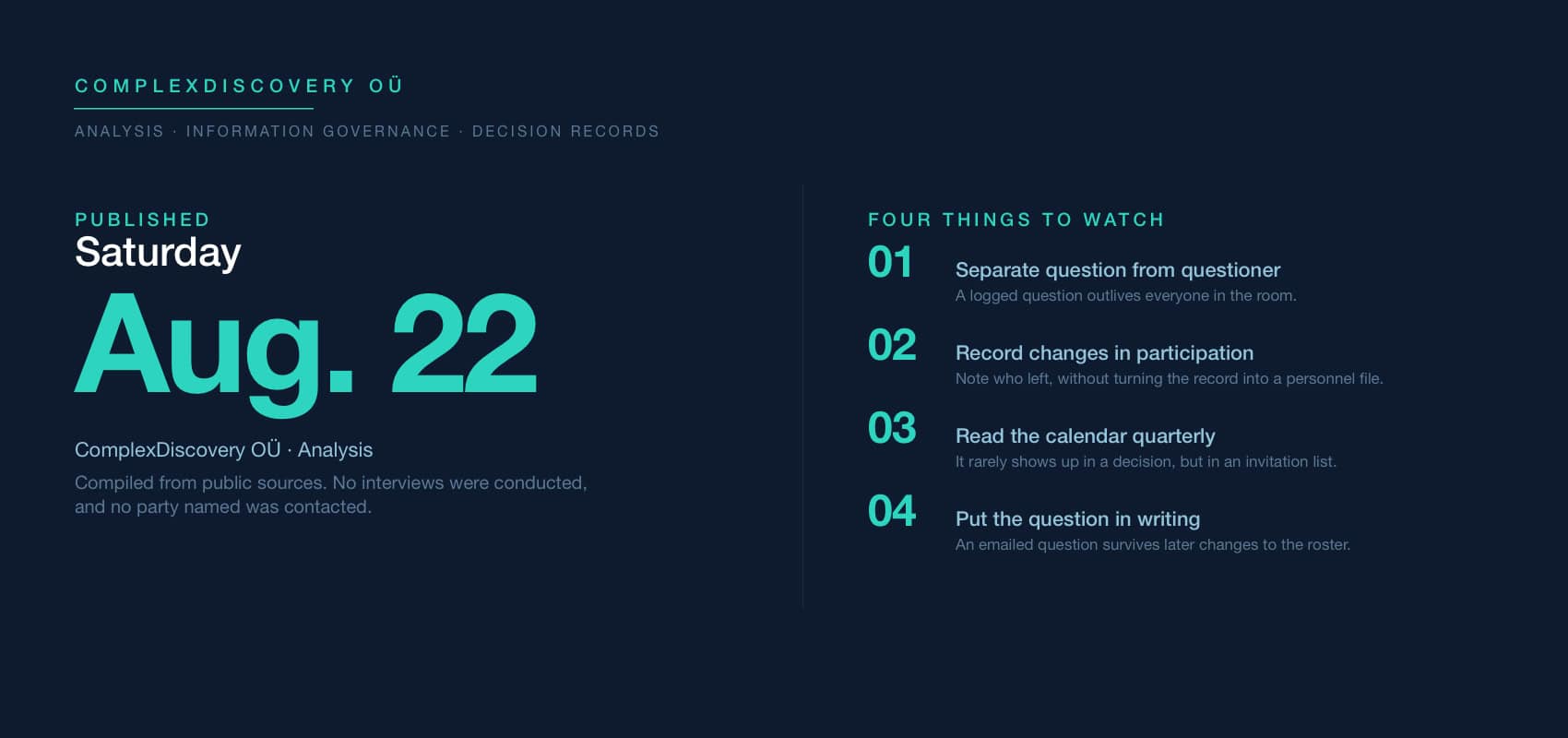
So separate the question from the questioner. A decision record that logs the open question, names who raised it and states what the group resolved to do about it turns a personality problem into a governance artifact, and it outlives everyone in the room. Record material changes in participation too, and keep responsibility for unresolved questions attached to someone by name. Where it is appropriate to say why participation changed, say so, without turning a decision record into a personnel file. An unexplained gap is what may later draw questions from counsel, regulators or auditors.
Then read the calendar against the roster quarterly. The exclusion in these stories does not show up in the decision. It shows up in an invitation list, a record that can pass through a review cycle untouched.
For anyone who suspects they are on the wrong side of this pattern, there is one practical move worth making first. Put the question in writing, to the group, before the meeting. It gives the decision file the thing it often lacks: evidence the question was asked at all. What survives after that depends on the organization’s retention practices, access controls and any applicable legal-hold or privilege considerations.
The next time your organization reaches consensus faster than expected, whose question went missing to make that happen, and what will it cost to hear it from a regulator instead?
News sources
- Report of the Presidential Commission on the Space Shuttle Challenger Accident, Chapter V: The Contributing Cause of the Accident (NASA)
- Psychological safety in the changing workplace: Work in America 2024 (American Psychological Association)
- The experience of working in America during times of change: Work in America 2025 (American Psychological Association)
- Ostracism more damaging than bullying in the workplace (University of British Columbia, via EurekAlert)
- Workplace Ostracism More Distressing Than Harassment (Association for Psychological Science)
- Is Negative Attention Better Than No Attention? The Comparative Effects of Ostracism and Harassment at Work (Organization Science)
- Organizational Silence: A Barrier to Change and Development in a Pluralistic World (Academy of Management Review)
- Psychological Safety and Learning Behavior in Work Teams (Administrative Science Quarterly, via ERIC)
- Minority Influence Theory, IRLE Working Paper 218-10 (UC Berkeley Institute for Research on Labor and Employment)
- 2023 Global Business Ethics Survey: Part 1 – GBES: A Snapshot of the Global Workforce Ethics (YouTube)
- Success bred complacency: a NASA warning for security and discovery leaders (ComplexDiscovery)
Assisted by GAI and LLM Technologies
Additional reading
- Motion isn’t momentum: A test for what your team actually produces
- The one question that reveals whether your marketing plan is actually a plan
- How Prompt Marketing Is Redefining Thought Leadership In The AI Era
- Raising The Age Ceiling: How AI Is Extending Executive Leadership
- Staying Curious: One Practical Defense Against Creative Burnout
- From Longbows To AI: Lessons In Embracing Technology
- 20 Ways Creative Professionals Battle Burnout And Find Fresh Ideas
- 14 Points For Brands To Consider Before Making Sociopolitical Statements
Source: ComplexDiscovery OÜ
ComplexDiscovery’s mission is to enable clarity for complex decisions by providing independent, data‑driven reporting, research, and commentary that make digital risk, legal technology, and regulatory change more legible for practitioners, policymakers, and business leaders.
The post From excitement to exclusion: what happens when leaders drop the questioner appeared first on ComplexDiscovery.