
Editor’s Note: ComplexDiscovery OÜ is publishing a three-term Oxford-style tutorial that asks whether, beyond awareness and credibility, marketing drives revenue in eDiscovery and legal technology. The question lands as B2B buyers report ranking their shortlists before they speak to a seller, according to 6sense’s 2025 survey of nearly 4,000 buyers.
For practitioners, the stakes are concrete. Provider marketing and sales leaders defend budgets with attribution figures, yet researchers analyzing 15 Facebook advertising experiments found that observational methods often failed to match randomized results. Legal operations and procurement teams build vendor lists from reputation and signals they cannot fully inspect. Information governance and cybersecurity buyers may face similar dynamics when they evaluate providers of their own.
The tutorial sets 21 propositions, each written to be argued either way, and demonstrates the method with three worked examples. Watch for how providers respond to buyer-led research in their 2027 planning, and whether measurement practice shifts from attribution dashboards toward randomized holdouts.
Disclosure: ComplexDiscovery OÜ’s founder also serves as chief marketing officer of an eDiscovery provider; the tutorial’s propositions are argued either way and are not the publication’s position.
News Analysis – Leadership Beat
Does marketing drive revenue? An Oxford-style tutorial for eDiscovery and legal tech
ComplexDiscovery Staff
Many provider marketing budgets in eDiscovery and legal technology rest on an assumption that is seldom argued out loud: that past a certain point, more marketing still produces more revenue. ComplexDiscovery OÜ has put that assumption on trial in the latest installment of The ComplexDiscovery Tutorial, adapting the Oxford tutorial for a field that often moves faster than it reflects.
The tutorial is built around one governing question. Once a firm is known and trusted, does further marketing spending cause revenue, or does it mostly take credit for revenue that sales relationships, referrals and reputation would have produced anyway?
The tutorial concedes the floor at the outset, noting that few serious observers argue that awareness and credibility are worthless; a provider no buyer has heard of rarely reaches a shortlist. The contested ground is everything above that floor, from demand generation and content programs to events, intent data and attribution dashboards, in a market where much of the work is bought through relationships, panels and procurement.
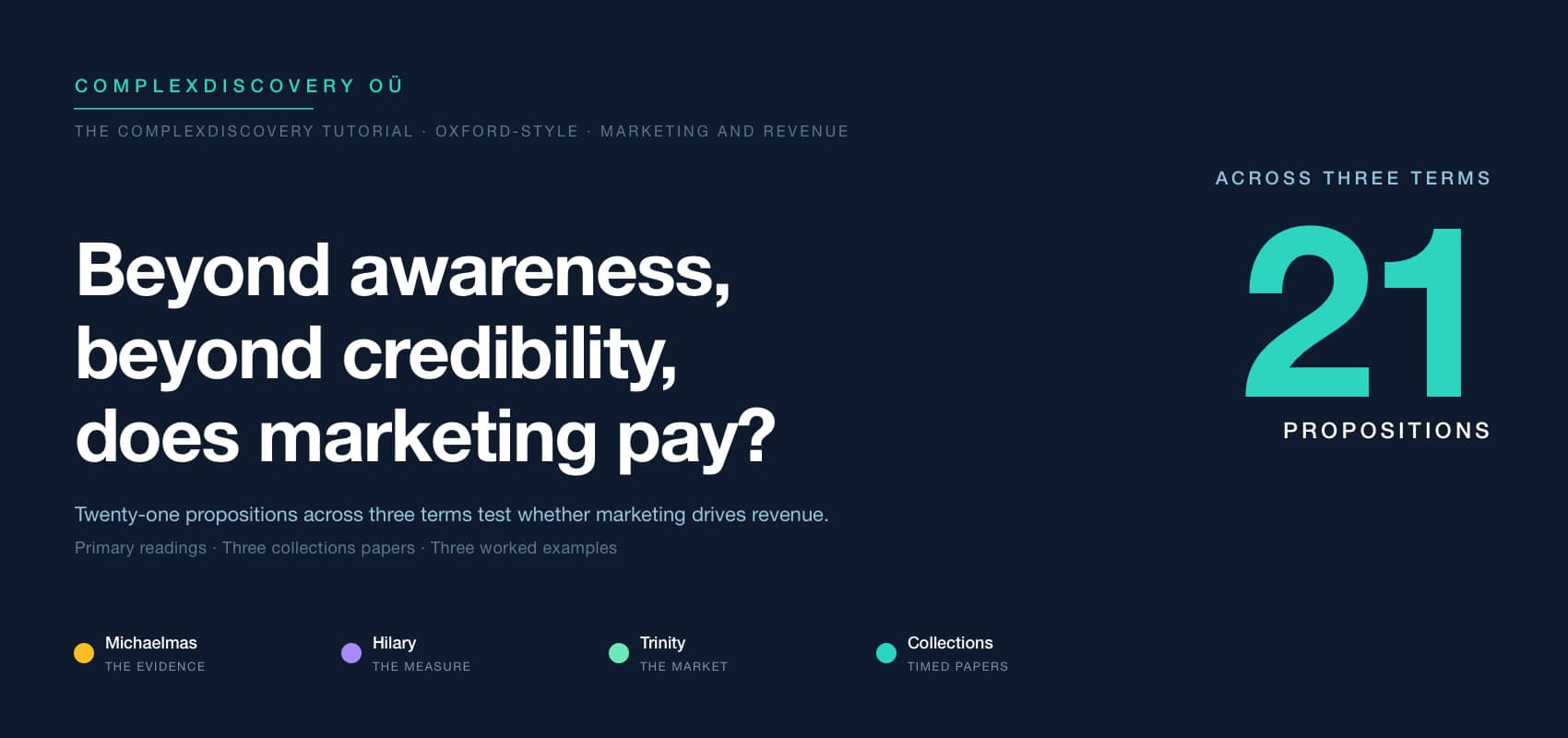
To work that ground, the curriculum sets 21 contestable propositions across three terms, each proposition paired with primary readings and an essay prompt, and closes each term with a collections paper. Three worked examples, one per term, let readers watch the method in use rather than take it on faith.
A disciplined conversation
The Oxford tutorial is less a lecture than a disciplined conversation. As the tutorial document frames it, the form is a weekly argument: a student writes an essay on an assigned proposition, reads it aloud and defends it against a tutor whose job is to find the weakest sentence. The essay is expected to take a side, use its readings as evidence rather than decoration and concede what it cannot defend.
The point is not to settle whether marketing works. It is to make every claim about marketing survive a hostile reader, whether that reader is a chief financial officer, a procurement lead or a skeptical colleague in sales.
A method, then three terms
The curriculum follows the Oxford academic calendar, whose three terms are Michaelmas (autumn), Hilary (winter) and Trinity (spring into early summer). Each term presses a different question: what the evidence says marketing does, whether anyone can measure it honestly and whether any of it holds in the legal technology market.
Michaelmas: the evidence
Michaelmas tests whether marketing causes sales at all, drawing on experimental and meta-analytic evidence, most of it from consumer markets. The first proposition (that once a firm is known and credible, further marketing adds little revenue) pairs Byron Sharp’s “How Brands Grow” with a 2021 Econometrica study by Bradley Shapiro, Günter Hitsch and Anna Tuchman, which found negative marginal returns on TV advertising for over 80 percent of the 288 consumer brands it examined. The second (that marketing works mainly on buyers who are not yet in the market, so its effect is real but deferred) draws on the 95-5 rule set out by John Dawes of the Ehrenberg-Bass Institute with The B2B Institute at LinkedIn, which holds that up to 95 percent of business buyers are out of the market at any given time, and on Les Binet and Peter Field’s “The Long and the Short of It.”
The third proposition (that measured advertising effects are smaller than marketers believe) rests on a 2011 meta-analysis by Raj Sethuraman, Gerard Tellis and Richard Briesch that reported a mean short-term advertising elasticity of 0.12 and a median of 0.05. The fourth asks whether visible spending signals quality a buyer cannot inspect, through Phillip Nelson’s “Advertising as Information” and Amna Kirmani and Akshay Rao’s review of signaling research. The fifth (that marketing routinely takes credit for demand it did not create) centers on an eBay field experiment by Thomas Blake, Chris Nosko and Steven Tadelis, in which brand keyword ads showed no measurable short-term benefit.
The sixth draws on Leonard Lodish and colleagues’ summary of 55 in-market TV experiments, which found that where a TV weight increase lifted sales in its first year, the total effect including the following two years was roughly double the first-year lift, while tests whose first-year effect fell short of statistical significance showed no later effect on average. The seventh turns on the tutorial’s own premise, asking whether awareness and credibility can be separated from revenue at all, with readings from Susan Mudambi, Peter Doyle and Veronica Wong on industrial branding and “The B2B Effectiveness Code,” produced by The B2B Institute at LinkedIn with WARC and Lions. The term closes with collections, a timed paper on the claim that marketing does not drive revenue but builds the conditions under which selling can.
Hilary: the measure
Hilary asks whether marketing’s revenue effect can be isolated in practice, or only asserted. Its first proposition borrows the saying that half of advertising money is wasted and no one knows which half (Quote Investigator names John Wanamaker the leading candidate but finds no direct source) and sets it beside Randall Lewis and Justin Rao’s finding that even large digital experiments produce return estimates too noisy to read with confidence. The second (that attribution models report correlation as contribution) draws on 15 Facebook experiments analyzed by Brett Gordon, Florian Zettelmeyer, Neha Bhargava and Dan Chapsky, in which observational methods often failed to match randomized results, and on Ron Berman’s critique of last-touch attribution.
The third proposition asks whether randomized holdouts are realistic at B2B scale, using the “ghost ads” method developed by Garrett Johnson, Randall Lewis and Elmar Nubbemeyer. The fourth applies the widely quoted phrasing of Goodhart’s law from anthropologist Marilyn Strathern (“When a measure becomes a target, it ceases to be a good measure”) to marketing-sourced pipeline quotas. The fifth treats “influenced revenue” as a definition rather than a finding and asks students to rewrite it so it could be proved false.
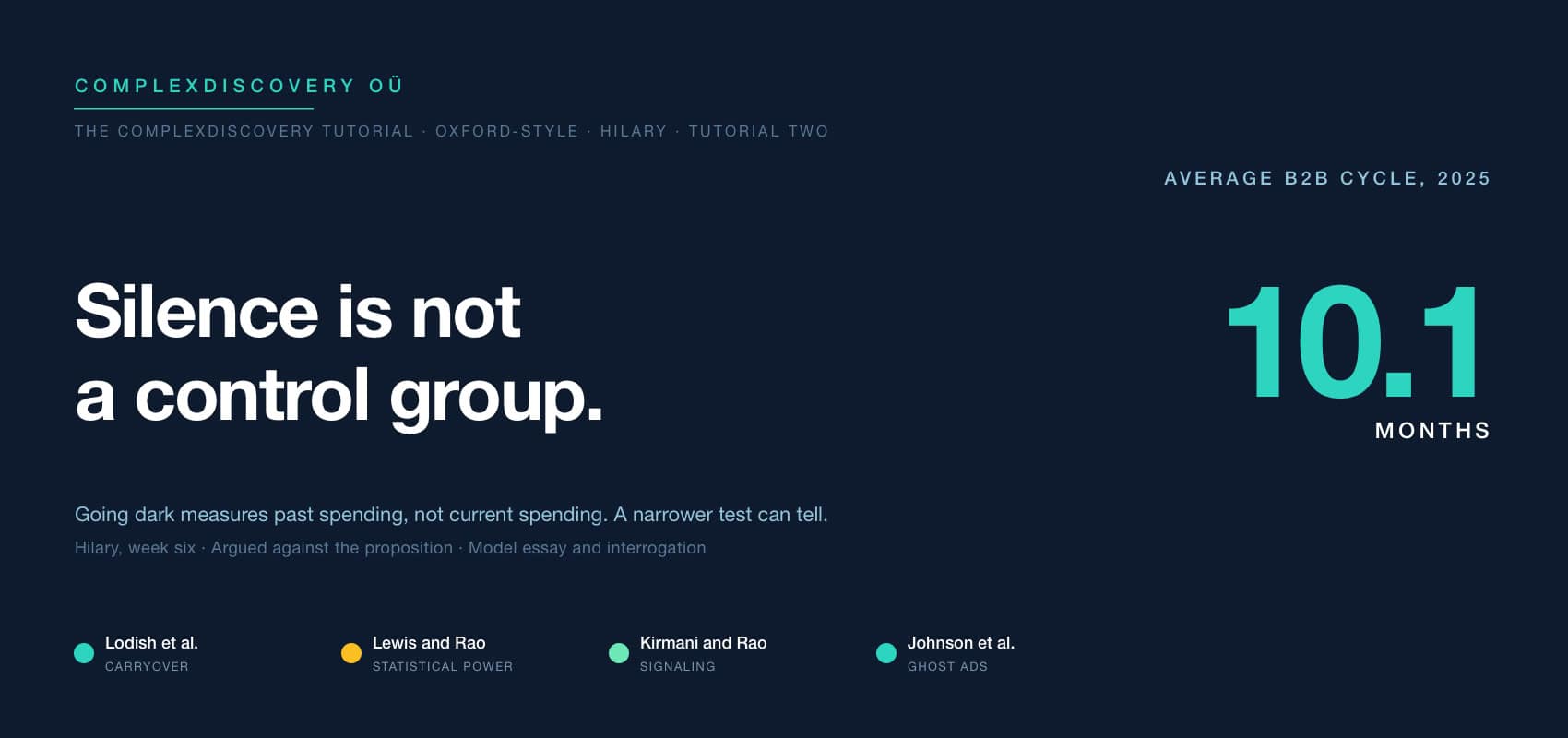
The sixth asks whether the honest test of marketing is what happens when it stops. The seventh asks whether, in a long and committee-driven sale, measurement fails before marketing does. In 6sense’s 2025 Buyer Experience Report, which surveyed nearly 4,000 B2B buyers, the average buying cycle ran 10.1 months. Collections sets the claim that if marketing cannot be measured honestly, it cannot be managed honestly.
Trinity: the market
Trinity moves the argument into eDiscovery and legal technology. It opens with the proposition that legal buyers buy people rather than brands, read through David Maister, Charles Green and Robert Galford’s “The Trusted Advisor” and Matthew Dixon and Brent Adamson’s “The Challenger Sale.” The second (that the shortlist is set before marketing can touch it) uses 6sense’s 2025 finding that B2B buyers made first contact with sellers about 61 percent of the way through their process and that 94 percent of buying groups had already ranked their shortlist. Those figures describe B2B buying broadly, not legal technology specifically. The third asks whether procurement has turned legal technology buying into a specification and price exercise, citing the Buying Legal Council’s 2021 survey, which, as reported by Corporate Counsel Business Journal, found procurement influenced 76 percent of legal technology purchases.
The fourth proposition tests whether thought leadership is the one form of marketing legal buyers reward, using a 2024 Edelman and LinkedIn study of 3,484 executives in which 86 percent of decision-makers said they would be “moderately likely” or “very likely” to invite an organization that consistently produces high-quality thought leadership into a request for proposal process when they are in the market. It also asks how much weight a report produced with a platform that sells the channel can bear. The fifth uses ComplexDiscovery OÜ’s 2025 to 2030 eDiscovery market size mashup, which places services at 66 percent of a $19.61 billion market in 2025, to ask whether marketing in a services-heavy market protects price rather than winning share.
The sixth sets a Gartner survey of 646 B2B buyers, 67 percent of whom preferred a rep-free experience, against Peter Drucker’s often-quoted line that the aim of marketing is to make selling superfluous. A second Gartner release drawn from the same fieldwork adds a counterweight: 69 percent of buyers prefer to validate AI-generated insights with sales representatives. The seventh, drawing on Theodore Levitt’s “Marketing Myopia,” asks whether “marketing or sales?” is the wrong question altogether. The final collections paper is the governing question itself: that beyond basic awareness and credibility, marketing does not matter in driving revenue.
The form in motion
The tutorial demonstrates its method with three worked examples, one per term, each pairing a model essay with a constructed interrogation. The exchanges are written simulations in composite voices, not transcripts, and are presented in full below.
The first, from Michaelmas, argues that marketing routinely takes credit for demand it did not create, building from the eBay experiment to B2B attribution. The tutor presses on whether a mid-market provider resembles a household brand, whether the essay has shown where the money goes or only where measurable engagement lands, and whether a buyer’s prior experience with a vendor caused the buyer’s ranking or merely accompanied it.
The second, from Hilary, argues against treating a marketing blackout as an honest test, citing carryover, cycle length, statistical power and the signal a silent firm sends. The tutor asks what evidence would ever change the student’s mind, and pushes the essay from “patient” to a specific test length.
The third, from Trinity, argues that buyer-journey statistics show the shortlist is set before sales can touch it, not before marketing can. The tutor asks whether the essay proves marketing’s case or only that something before the sales call matters, and follows the argument back to the floor the tutorial concedes at the start.
Running it against your own work
The tutorial is designed to be run alone as well as in pairs. A reader can take any proposition, write the strongest essay for the side they do not hold, then interrogate it as a tutor would: what is the counterfactual, what would change the writer’s mind, and does the conclusion claim beyond what the evidence supports?
The payoff differs by seat. For a provider’s marketing leader, it is a rehearsal for the budget meeting where every figure meets a skeptical reader. For a sales leader, it is a way to separate the deals marketing created from the deals it recorded. For legal operations and procurement teams, it is a lens on how their own shortlists form, and on which signals they trust when they cannot inspect quality in advance.
One caution runs through the reading list. Much of the strongest causal evidence comes from consumer markets, the buyer-journey surveys describe B2B buying broadly rather than legal technology in particular, and several of the B2B studies were produced or commissioned by firms that sell or operate the channels they measure. The tutorial asks readers to weigh all three facts, not to discard the evidence.
The exercise for any team is the one the tutorial is built on. Put marketing’s strongest claim about revenue in front of a hostile examiner. Which sentence breaks first?
The tutorials in full
The three worked examples below are illustrative examples provided by ComplexDiscovery OÜ. Each pairs a model essay with a constructed interrogation: a written simulation of a tutorial exchange in composite, illustrative voices, not a transcript of a live session between real people. The studies, surveys and scholars the essays cite are real and were checked against publisher, journal, repository and news pages. The propositions are written to be argued either way, and the side each essay takes is an exercise, not a position held by ComplexDiscovery OÜ.
Tutorial one, Michaelmas: “That marketing routinely takes credit for demand it did not create”
Explainer
This example trains the first habit of the term: asking what would have happened without the intervention. Watch how the essay builds from a single consumer experiment to a claim about B2B attribution, and how the tutor tests whether that bridge can carry the weight placed on it.
The essay
Michaelmas, week five. The student was asked to argue for the proposition, using Blake, Nosko and Tadelis (2015) and at least two other Michaelmas readings.
The click that was already coming
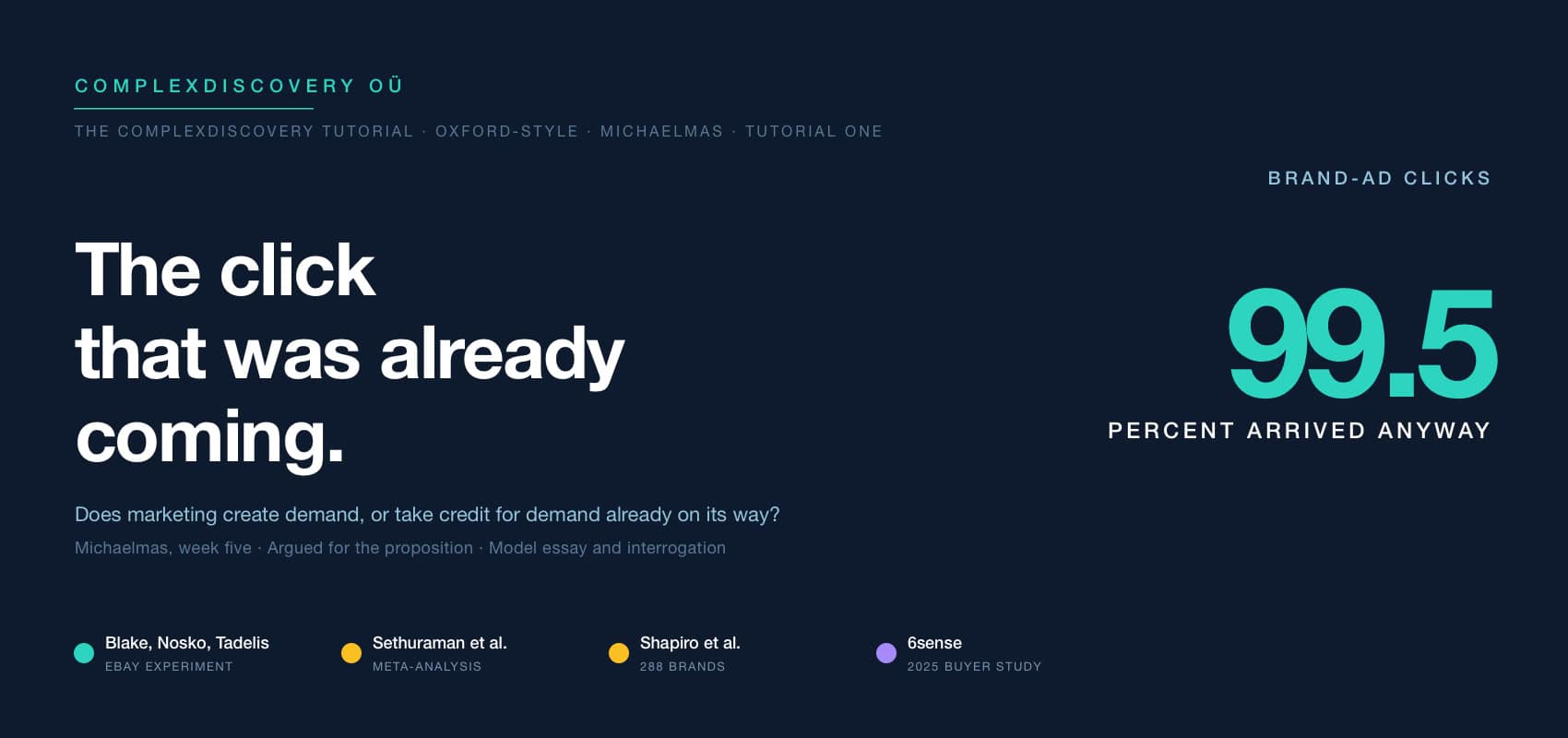
When eBay stopped buying search ads on its own brand name on MSN and Yahoo, almost nothing happened. Blake, Nosko and Tadelis report that 99.5 percent of the click traffic those ads had been delivering arrived anyway, through the unpaid search results sitting just below them. The ads had been counting that traffic as their own.
I will argue that this experiment is not a curiosity about search engines. It is a precise description of how marketing is credited in most firms, and B2B firms that sell into legal departments and law firms are more exposed to it than eBay, not less.
First, the mechanism. Marketing is placed where buyers already are. A brand keyword ad appears only to someone who typed the brand. A retargeting ad follows someone who already visited. A nurture email reaches someone who already gave an address. Each of these touches selects for people who were on their way, and then records their arrival. The eBay authors show what that selection does to the numbers. For non-brand search ads, a simple regression of sales on spending implied returns of over 4,000 percent. Adding controls for day and geography still left an estimate above 1,500 percent. The controlled experiment found a return of minus 63 percent. Nothing about the ads changed between those figures. What changed was the question: from “who bought after seeing an ad?” to “who bought because of one?”
Second, the mechanism in eDiscovery. A provider’s most likely buyers are its current clients, its former clients and the colleagues those people talk to. They attend its webinars because they already use it. They download its reports because they already trust it. When a matter arrives and a contract follows, the customer relationship management (CRM) system looks back, finds a webinar registration and a report download, and records the deal as marketing-influenced or even marketing-sourced. A 2025 study by 6sense of nearly 4,000 B2B buyers gives a sense of scale: 94 percent of buying groups had ranked their shortlist before engaging sellers, and 85 percent of buyers reported prior experience with the vendor they ultimately chose. A buyer who arrives with a ranked shortlist and a history is the B2B equivalent of someone typing “eBay” into a search bar. The touch is real. The causation is borrowed.
Third, the size of careful estimates. Sethuraman, Tellis and Briesch, pooling 751 short-term estimates from published studies, found a mean advertising elasticity of 0.12 and a median of 0.05, well below the 0.22 mean an earlier meta-analysis reported. Shapiro, Hitsch and Tuchman, using a research design built to limit confounding across 288 consumer brands, found negative marginal returns on TV advertising for over 80 percent of them. These are consumer studies, and I will not pretend they transfer cleanly. But they suggest a pattern: the more carefully effects are estimated, the smaller they tend to look. If a provider’s dashboard credits marketing with returns far above what careful studies find, that gap is a hypothesis to test before it is a result to report. Until the test is run, the likelier explanation is not that legal technology marketing is unusually potent. It is that the dashboard is counting clicks that were already coming.
The incentive makes this worse. A marketing team measured on sourced pipeline has every reason to place touches as close to the buyer’s decision as possible, where credit is cheapest to collect. That is the brand keyword strategy, applied to webinars and gated reports. It is rational for the team and expensive for the firm.
The strongest objection comes from the same paper. The eBay authors found that paid search had measurable effects on new and infrequent users, with the largest effect among users who had not bought on eBay before, while the effect faded for frequent buyers. Marketing that reaches strangers can create demand. I accept this. But it sharpens the proposition rather than defeating it. Most of a known provider’s measurable engagement comes from people who already know it, because that is where engagement metrics are easiest to produce. The stranger is expensive to reach and slow to convert, and so the stranger is underfunded.
The proposition is true as a description of how marketing is usually credited. Whether it is true of what marketing could do is a different question, and the answer depends on whether a firm is willing to stop paying for the click that was already coming and spend instead on the buyer who has never heard of it.
The interrogation
Tutor: You open with eBay. Why should a reader in legal technology care what happens to a household name selling consumer goods?
Student: Because the mechanism doesn’t depend on the product. Any firm that places touches where its existing buyers already are will over-count.
Tutor: But the size of the effect depends on how well known the firm is. eBay’s brand ads were redundant because everyone already knew eBay. Is a mid-market eDiscovery provider closer to eBay or to a stranger?
Student: For its existing clients, closer to eBay. For the rest of the market, closer to a stranger.
Tutor: Then your essay needs two numbers it does not have. What share of the provider’s marketing reaches each group?
Student: I don’t have them. I’d argue most engagement comes from the first group, because they’re the ones who open the emails.
Tutor: “Most engagement” is not “most spending.” A conference sponsorship reaches strangers and clients alike. Have you shown that the money, rather than the measurable engagement, goes to people who already know the firm?
Student: No. I’ve shown the measurement is biased toward them. That’s a narrower claim.
Tutor: It may be the claim you can defend. Let’s test the B2B bridge. You cite 94 percent with a ranked shortlist before contact. Who formed that ranking?
Student: Prior experience, mostly. The same study says 85 percent had prior experience with the vendor they chose.
Tutor: Experience with the winner. Does that tell you the experience produced the ranking?
Student: Not directly. It’s consistent with it.
Tutor: Consistent with it, and with a relationship that marketing helped open years earlier. Be careful not to read the causation you need into the correlation you have. Now: what is the counterfactual for a webinar attendee who later signs?
Student: That they would have signed without the webinar.
Tutor: How would you know?
Student: Randomize the invitations. Hold some accounts out of the webinar series and compare conversion.
Tutor: With how many accounts?
Student: A few hundred, for most providers.
Tutor: That is Hilary’s problem, so I’ll leave it there. Last question. Suppose you’re right and credit-taking is widespread. Is the remedy less marketing, or better accounting?
Student: Better accounting first. Then less of the marketing that the accounting shows was taking credit.
Tutor: And more of what?
Student: Of the work that reaches people who don’t know the firm yet. The concession, really.
Tutor: Then your conclusion argues against your title. The proposition says marketing takes credit. Your essay ends by saying some of it creates demand and is underfunded. Rewrite the last paragraph so it owns both halves.
Tutorial two, Hilary: “That the honest test of marketing is what happens when it stops”
Explainer
This example trains the central discipline of Hilary: separating “unmeasured” from “unmeasurable,” and designing a test before defending a verdict. Watch the essay’s strongest move (carryover) and the tutor’s question about whether the essay has quietly made its own claim impossible to disprove.
The essay
Hilary, week six. The student was asked to argue against the proposition, drawing on Lodish et al. (1995), Lewis and Rao (2015) and at least one other reading from the term.
Silence is not a control group
There is a version of this proposition that every chief financial officer finds attractive. Stop the marketing for a quarter. If revenue holds, the spending was waste. If revenue falls, the spending was earning its keep. It sounds like an experiment. I will argue that it is not one, and that a firm that runs it learns less than it thinks and may pay for the lesson later.
First, carryover. Lodish and colleagues, summarizing 55 in-market TV experiments, found that when a weight increase lifted sales in its first year, the total effect, including the following two years, was roughly double the first-year lift. Advertising that works keeps paying after the spending ends. Run that logic in reverse. A firm that goes dark is still collecting on past investment, so revenue in the dark quarter reports the decay rate of what was spent before, not the value of what was being spent now. The test is built to report “no harm” early.
Second, the calendar. A 2025 study by 6sense of nearly 4,000 B2B buyers puts the average buying cycle at 10.1 months, and 11.1 months in North America. Deals that close in the quarter a provider goes quiet were, on that average, opened most of a year earlier. A one-quarter pause measures the pipeline the firm built last year. Its effect on the pipeline the firm would have built this year shows up after the test has been declared over.
Third, statistical power. Lewis and Rao examined 25 large digital advertising field experiments, most reaching over a million customers, and found individual sales so volatile relative to advertising effects that the median retail experiment produced a confidence interval on return on investment over 100 percentage points wide. A provider with a few hundred target accounts, each placing irregular and outsized orders, is in a far worse position. The question “did revenue fall when we stopped?” may be difficult to answer at that scale with confidence, in either direction, unless a power analysis shows otherwise.
Fourth, going dark is itself a message. Kirmani and Rao review the argument that visible spending can signal confidence in quality, because only firms expecting repeat business can afford it. If spending can carry that signal, withdrawal may be read the other way, and not only by buyers. That is an inference rather than a finding. Still, the audiences are easy to name: competitors notice an empty booth, recruits notice a silent feed and analysts notice a missed briefing. If any of them reacts, the test changes the market it is trying to measure.
The best case for the proposition is that without some holdout, every claim marketing makes about itself is unfalsifiable, and that is worse than an imperfect test. Shapiro, Hitsch and Tuchman’s finding that over 80 percent of 288 brands had negative marginal returns on TV advertising suggests many firms could spend less and earn more, and a firm that never stops will never learn whether it is one of them. I accept the principle. I reject the method.
The honest test is narrow, randomized and patient. Johnson, Lewis and Nubbemeyer’s ghost ads design shows that measurement can compare buyers who saw a campaign with comparable buyers who would have seen it, without darkening the whole market. A provider can hold a random set of accounts out of a named program, keep everything else running and wait. Gordon and colleagues’ Facebook experiments show why the randomization matters: observational methods often failed to recover the effects the experiments measured, even with rich data on every user.
Stopping everything is a test of nerve, not of marketing. The proposition is right that marketing should be tested by its absence. It is wrong about whose absence, and for how long.
The interrogation
Tutor: You list four objections to going dark. If going dark is never a fair test, what evidence would ever persuade you that a provider’s marketing does nothing?
Student: A randomized holdout of accounts from a program, run long enough, showing no difference.
Tutor: And if the provider can’t find enough accounts to detect a difference?
Student: Then it can’t prove the marketing works either.
Tutor: Which leaves it where?
Student: Spending on faith.
Tutor: Your essay says the answer is uncertain “in either direction,” then treats that uncertainty as a reason to keep spending. Lewis and Rao cut both ways: if you can’t detect the effect of stopping, you can’t detect the effect of continuing. Why should the default be to keep spending?
Student: Because of carryover. Stopping has a delayed cost you won’t see in time.
Tutor: Lodish also found that tests whose first-year effect fell short of statistical significance showed no later effect on average. Doesn’t that weaken your carryover argument for programs that never showed an early signal?
Student: It does. It means carryover protects only marketing that was already working.
Tutor: So a provider could cut the programs that never showed anything and keep the ones that did.
Student: If it could tell which were which.
Tutor: Take the signaling point. You say an empty booth tells the market something. How much of that is a revenue effect, and how much is a marketing team’s anxiety about being visible?
Student: I can’t separate them. I’d say the signal matters most to recruits and analysts, which are indirect routes to revenue.
Tutor: Indirect routes are where unfalsifiable claims live. Is “it takes too long to show” an argument or a shelter?
Student: It’s an argument when you can say how long, and a shelter when you can’t.
Tutor: Then say how long. You have a cycle length in your own essay.
Student: The study says 10.1 months on average. As a planning assumption, a program holdout should run at least one full cycle, so roughly a year, adjusted to the provider’s own cycle data, before anyone reads the result.
Tutor: Good. Put that number in your conclusion, and say where it came from. “Patient” is an adjective. “One full buying cycle” is a test.
Tutorial three, Trinity: “That the shortlist is set before marketing can touch it”
Explainer
This example trains a Trinity habit: reading a statistic against the conclusion it is usually recruited to support. Watch how the essay turns the proposition’s own evidence around, and how the tutor asks whether the reversal proves marketing’s case or only that something before the sales call matters.
The essay
Trinity, week two. The student was asked to argue against the proposition, using the 6sense 2025 study and at least one reading on legal procurement.
Who was in the room before the room
The proposition rests on figures that circulate at every sales kickoff. In 6sense’s 2025 Buyer Experience Report, which surveyed nearly 4,000 B2B buyers, respondents made first contact about 61 percent of the way through their purchasing process and initiated that contact 79 percent of the time. In 94 percent of buying groups, the shortlist was already ranked by preference, and 77 percent of buyers had their first vendor conversation with the eventual winner. A Gartner survey of 646 B2B buyers, fielded in August and September 2025, found that 67 percent would prefer a buying experience without a sales representative. In legal technology the gate narrows further: the Buying Legal Council’s 2021 survey, as reported by Corporate Counsel Business Journal, found procurement influenced 76 percent of legal technology purchases. The usual conclusion is that the deal is decided before anyone can influence it.
I will argue that these figures prove less than the proposition claims, and point the other way. They show the shortlist is set before sales can touch it. They do nothing to show it is set before marketing can.
First, what a ranked shortlist requires. A buyer who arrives with a favorite has formed a view from something. The candidates are few: prior work with the provider, word of mouth from peers, what the buyer has read, heard and seen, and where the provider stands with analysts and on procurement lists. Of these, only prior work sits entirely outside marketing’s reach. Peer conversation is shaped by what peers have read. Analyst coverage and panel inclusion are earned in part through briefings, published material and visibility at the events where legal professionals gather. The share of the journey completed before contact fell from about 69 percent in 2024 to about 61 percent in 2025, but most of it still happens before sales arrives. If the decision is largely made in that stretch, then it is where the contest happens, and it is the part of the journey marketing, not sales, occupies.
Second, timing. Dawes, of the Ehrenberg-Bass Institute, argues in work with The B2B Institute at LinkedIn that up to 95 percent of business buyers are not in the market for a given service at any moment. The memory a buyer draws on when a matter arrives was built while they were not buying. A shortlist set before contact was, on this account, set during the long period when the buyer was reading, attending and remembering with no intent to purchase. That is the period the proposition says marketing cannot reach. It is the stretch of the journey that marketing can reach and sales usually does not.
Third, the legal market’s own structure. ComplexDiscovery OÜ’s 2025 to 2030 eDiscovery market size mashup places services at 66 percent of a $19.61 billion eDiscovery market in 2025. Services are bought on trust in people and process, qualities a buyer cannot inspect before the work begins. Nelson’s distinction between search goods and experience goods applies: when quality can only be judged after purchase, buyers lean on reputation and signals. Procurement does not remove that dependence. It formalizes it, by turning reputation into a vendor list that someone first had to get onto.
The objection I take most seriously comes from the same 6sense study: 85 percent of buyers reported prior experience with the vendor they chose, and 68 percent already knew a seller there. If the winner is usually a vendor the buyer has already used, then the shortlist is set by delivery, and marketing is a bystander. I cannot rule this out with the data available. Even so, it does not rescue the proposition. A shortlist set by past delivery is set before this deal’s marketing, but the first engagement that led to that delivery had to begin somewhere.
The proposition is wrong as written. The shortlist is set before the sales conversation, during hours that belong to reputation, and marketing is one of the few forces at work in those hours. Whether it is the decisive one is a question these surveys cannot answer.
The interrogation
Tutor: You’ve turned the statistics around neatly. Now turn them back. What does a preference built by delivering a matter look like, compared with one built by a campaign?
Student: The first comes from someone who worked with the provider’s team. The second comes from someone who only knows the brand.
Tutor: Which kind does the 6sense ranking describe?
Student: It doesn’t say. It reports a ranking, not where the ranking came from.
Tutor: So your essay proves that something before sales matters. Does it prove that marketing is that something?
Student: It shows marketing is one of the few things operating in that window.
Tutor: One of a few. Name the others and rank them.
Student: Prior work, peer referral, analyst and panel position, published reputation. For eDiscovery services, honestly, I’d rank prior work and referral first.
Tutor: Your conclusion calls marketing one of the few forces at work; your own ranking puts it behind prior work and referral. The final paragraph should say so. Next: you say the first engagement “had to begin somewhere.” Where did it begin for a provider assembled through acquisitions, or founded by a team that left a competitor?
Student: With relationships the people brought with them.
Tutor: Not with marketing.
Student: Not originally. Marketing might keep those relationships warm.
Tutor: “Might keep them warm” is a different essay. A harder case: imagine a market where every credible provider markets equally well. What happens to your argument?
Student: Marketing stops differentiating. It becomes the price of being considered.
Tutor: Which is?
Student: Awareness and credibility. The floor in the governing question.
Tutor: So in a mature market, your essay collapses into the same concession the tutorial grants at the start.
Student: Unless one provider markets better than the others.
Tutor: Then the question becomes whether “better” can be measured, which is Hilary’s problem again. Last: procurement. You say it formalizes reputation into a vendor list. Who decides which vendors make the list?
Student: Legal operations and procurement, usually with input from the lawyers who used them.
Tutor: Then the list is the lawyers’ experience in a spreadsheet. Where is marketing in that?
Student: In getting a provider in front of those lawyers the first time. I can’t show it does anything beyond that.
Tutor: Then say so. An essay that knows the limit of its evidence is stronger than one that hides it.

An invitation
The tutorial does not end with a verdict. Its final paper sets the governing question as written, and it is meant to be argued from either side.
Treat it as an invitation to argue the position you do not hold. If you believe marketing drives revenue, write the essay for “That marketing routinely takes credit for demand it did not create.” If you believe it does not, write against “That the shortlist is set before marketing can touch it.” Then hand the essay to someone who will interrogate it.
The questions cost nothing. The thinking is the work.
Sources and reference materials
References are cited in full; titles link to a public version where one exists.
ComplexDiscovery OÜ
- ComplexDiscovery OÜ. “Complete look: ComplexDiscovery OÜ’s 2025 to 2030 eDiscovery market size mashup.” June 26, 2026.
Scholarship and commentary
- Berman, Ron. “Beyond the Last Touch: Attribution in Online Advertising.” Marketing Science 37, no. 5 (2018): 771-792.
- Binet, Les, and Peter Field. The Long and the Short of It. IPA, 2013.
- Blake, Thomas, Chris Nosko, and Steven Tadelis. “Consumer Heterogeneity and Paid Search Effectiveness: A Large-Scale Field Experiment.” Econometrica 83, no. 1 (2015): 155-174.
- Dawes, John. “Advertising Effectiveness and the 95-5 Rule: Most B2B Buyers Are Not in the Market Right Now.” Ehrenberg-Bass Institute for Marketing Science with The B2B Institute at LinkedIn, 2021.
- Dixon, Matthew, and Brent Adamson. The Challenger Sale: Taking Control of the Customer Conversation. Portfolio/Penguin, 2011.
- Drucker, Peter F. Management: Tasks, Responsibilities, Practices. Harper & Row, 1973.
- Gordon, Brett R., Florian Zettelmeyer, Neha Bhargava, and Dan Chapsky. “A Comparison of Approaches to Advertising Measurement: Evidence from Big Field Experiments at Facebook.” Marketing Science 38, no. 2 (2019): 193-225.
- Johnson, Garrett A., Randall A. Lewis, and Elmar I. Nubbemeyer. “Ghost Ads: Improving the Economics of Measuring Online Ad Effectiveness.” Journal of Marketing Research 54, no. 6 (2017): 867-884.
- Kirmani, Amna, and Akshay R. Rao. “No Pain, No Gain: A Critical Review of the Literature on Signaling Unobservable Product Quality.” Journal of Marketing 64, no. 2 (2000): 66-79.
- Levitt, Theodore. “Marketing Myopia.” Harvard Business Review (July-August 1960): 45-56.
- Lewis, Randall A., and Justin M. Rao. “The Unfavorable Economics of Measuring the Returns to Advertising.” Quarterly Journal of Economics 130, no. 4 (2015): 1941-1973.
- Lodish, Leonard M., Magid M. Abraham, Jeanne Livelsberger, Beth Lubetkin, Bruce Richardson, and Mary Ellen Stevens. “A Summary of Fifty-Five In-Market Experimental Estimates of the Long-Term Effect of TV Advertising.” Marketing Science 14, no. 3, supplement (1995): G133-G140.
- Maister, David H., Charles H. Green, and Robert M. Galford. The Trusted Advisor. Free Press, 2000.
- Mudambi, Susan M., Peter Doyle, and Veronica Wong. “An Exploration of Branding in Industrial Markets.” Industrial Marketing Management 26, no. 5 (1997): 433-446.
- Nelson, Phillip. “Advertising as Information.” Journal of Political Economy 82, no. 4 (1974): 729-754.
- Nelson, Phillip. “Information and Consumer Behavior.” Journal of Political Economy 78, no. 2 (1970): 311-329.
- Sethuraman, Raj, Gerard J. Tellis, and Richard A. Briesch. “How Well Does Advertising Work? Generalizations from Meta-Analysis of Brand Advertising Elasticities.” Journal of Marketing Research 48 (June 2011): 457-471.
- Shapiro, Bradley T., Günter J. Hitsch, and Anna E. Tuchman. “TV Advertising Effectiveness and Profitability: Generalizable Results from 288 Brands.” Econometrica 89, no. 4 (2021): 1855-1879.
- Sharp, Byron. How Brands Grow: What Marketers Don’t Know. Oxford University Press, 2010.
- Strathern, Marilyn. “‘Improving Ratings’: Audit in the British University System.” European Review 5, no. 3 (1997): 305-321.
Industry research and surveys
- The B2B Institute at LinkedIn, with WARC and Lions. The B2B Effectiveness Code. October 2021.
- Buying Legal Council. 2021 Legal Procurement Survey. As reported in “Buying Legal Council Releases 2021 Legal Procurement Survey.” Corporate Counsel Business Journal, May 2021.
- Edelman and LinkedIn. 2024 B2B Thought Leadership Impact Report.
- “Gartner Sales Survey Finds 67% of B2B Buyers Prefer a Rep-Free Experience.” Press release, March 9, 2026.
- “Gartner Survey Finds 69% of B2B Buyers Turn to Sales Reps to Validate AI-Generated Insights.” Press release, May 20, 2026.
- 2025 B2B Buyer Experience Report. November 2025.
- Dodd, David. “Research Round-Up: 6sense Study Provides Critical Insights on B2B Buyer Behavior.” CustomerThink, Nov. 30, 2025.
Reference
- Quote Investigator. “Quote Origin: One-Half the Money I Spend for Advertising Is Wasted, But I Have Never Been Able To Decide Which Half.” April 11, 2022.
- University of Oxford. “Your Academic Year.”
Assisted by GAI and LLM Technologies
Additional reading
- When the agent becomes a witness: an Oxford-style tutorial on AI evidence, accountability and discovery
- An Oxford tutorial for newsroom leaders who must learn faster than the news
- An Oxford tutorial for cybersecurity, governance and eDiscovery
- Estonia aims to be first to give AI agents official digital IDs
- Parliament hits pause on high-risk AI rules and bans nudifier apps
- Europe’s AI labeling rules arrive with a voluntary code and a hard deadline
- AI is becoming an advisor, and it is rewriting how buyers find you
- What marketing confidence actually looks like
- When credibility comes first, capability sells itself: The case for news-led marketing
- The one question that reveals whether your marketing plan is actually a plan
- How Prompt Marketing Is Redefining Thought Leadership In The AI Era
- Raising The Age Ceiling: How AI Is Extending Executive Leadership
- Staying Curious: One Practical Defense Against Creative Burnout
- From Longbows To AI: Lessons In Embracing Technology
- 20 Ways Creative Professionals Battle Burnout And Find Fresh Ideas
- 14 Points For Brands To Consider Before Making Sociopolitical Statements
Source: ComplexDiscovery OÜ

ComplexDiscovery’s mission is to enable clarity for complex decisions by providing independent, data‑driven reporting, research, and commentary that make digital risk, legal technology, and regulatory change more legible for practitioners, policymakers, and business leaders.
The post Does marketing drive revenue? An Oxford-style tutorial for eDiscovery and legal tech appeared first on ComplexDiscovery.