
Reading Time: 9 minutes
The chairman of the American law firm, Paul Weiss &c, resigned after his connections to convicted sex offender Jeffrey Epstein became known. It’s hardly surprising that the first law firm to put its business model before its professional legal ethics during the second Trump Administration was led by someone with questionable personal connections. The legal profession seems to be suffering from a great deal of poor leadership examples. What I struggle to understand is why people bound by professional ethics and, in many cases, an oath to follow the law follow these people in positions of power?
I don’t know the ins and outs of Brad Karp’s dealings with sex offenders like Jeffrey Epstein and President Trump. I don’t frankly care. I have started to read Above the Law and their insight meets the level of curiosity I can muster:
[Karp] went on to praise an argument suggesting that the “‘victims’ lied in wait and sat on their rights for their strategic advantage,” a line that is… a choice. And then he goes on to make a middling joke about the sexual assault the victims allege. Citing U.S. v. Fokker Services to argue courts couldn’t reject a non-prosecution agreement, Karp added, “Wish there was a different case name than ‘Fokker,’ but we can’t have everything. In all seriousness, I don’t see a credible counter to our arguments. The case law is totally stacked in favor of our position.” Those emails don’t read like distant, incidental contact. They read like lawyering.Brad Karp’s Paul, Weiss Reign Ends With An Epstein-File Plot Twist, Kathryn Rubino, Above the Law, February 5, 2026
As someone who has a relatively low opinion of large law firms, through my personal experience with lawyers from Foley and Wilmer Hale, among others, it’s not like my faith in humanity was shaken. These are not organizations that I would want to work in or people I’d want to work for. So I don’t really understand how other people do it, year in and year out.
That’s not to say I haven’t heard the explanations. Even in a good economy where jobs are plentiful, people stay in bad organizations because their immediate team is a happy place for them. They are behind a firewall or are compensated in a way they feel they deserve or are otherwise able to navigate the poor leadership choices. It’s someone else’s job that gets eliminated or some customer or staff person that is treated poorly.
I wonder, though, when you have an organization like the current Department of Justice how you can continue to rationalize your lower-level role in an organization that is acting in such an overtly unethical manner. At some point, you will be tarred by the same brush merely by having participated. Unless lawyers stand up, like Julie Le who both spoke up in court and submitted her resignation, to be counted in opposition to the unethical behavior, you’re counting yourself a supporter. Bad apples all the way down.
It Only Takes One Decision
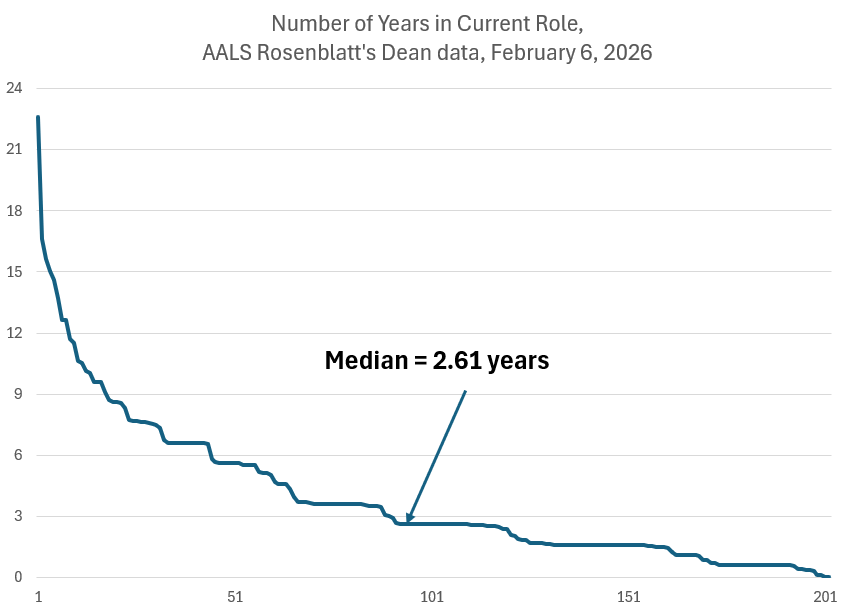
If this was a one-off in the legal profession, then it would be easy to ignore. But what about the University of Arkansas decision to renege on an offer to a new Dean? Admittedly, this one is less a law school leader as one where poor leadership impacts future lawyers. It’s not like law schools are doing a great job of retaining and nurturing deans. The ABA said that almost 25% of law schools were lead by a new dean in 2025. Due to the University Provost’s decision, Dean Nance’s intended three year stay—her second period of service as the law school dean—looks like it may go on longer than many law school deans’ longevity. It makes you wonder, though, who would want to follow in Dean Nance’s footsteps if they risk being treated the way Associate Dean Suski was.
Or my own alma mater, the University of Arkansas at Little Rock, who fired a professor for their comments about Charlie Kirk. Prof. Branch had been on the faculty for only a few months. I was flabbergasted that a law school would terminate an employee in such a situation.
I am not so naive as to believe that these law school decisions are happening in a vacuum. I get that there’s fear and it is frankly easier to cut people loose than risk larger repercussions. It is also true that leaders always work in challenging environments. It’s the whole job, to navigate difficult times and uncertainty so that the people who work for you can get the actual work done. If it’s not a government leavened with thousands of lawyers intent on breaking the law, it will be something else.
I have not worked at UALR since law school so I have no mechanism to show my displeasure with the school’s termination of Prof. Branch. I notified the school that, as an alumnus, I didn’t want to hear from them again due to this action. I am unlikely to be a loss to the school’s development but it was the most I could do. I’m still grateful to have gotten my start there but organizations will feel impacts when their leaders fail.
I have also been fortunate to be able to be very selective about who I choose to work for. If anything, as I gained in experience, I have chosen roles where I was confident that I was working for someone I could trust and respect. When those circumstances have changed, I’ve moved on.
There is a saying that people don’t leave companies, they leave managers. To a certain extent, I think that may be true. No one wants to work for a martinet or a micro manager and so people leave when leaders are extremely bad. But people will also stay in an organization with bad managers and immoral leaders, so it’s not a reliable rule. When I was working at Southern Methodist University, the leadership problem that encouraged me to leave was not in the library, where I had a great Associate Director as a boss and a great library director. But the Dean was an early example of someone who had a law degree and little idea of how to manage people. I was not wholly surprised when he was dropped by the University Provost for his own poor decision-making, nor that, while outsiders valued his money-raising, students had not had a very positive experience.
[quoting a student] Sure, he’s raised money, and lots of it. But raising money at SMU is as much of a challenge as getting laid at a whore house. The bottom line is that Dean Attanasio is immensely arrogant (his image once appeared on half the pages in the annual alumni magazine), he is a relic of the past (he cannot use a computer, so his emails are printed and hand-delivered to him by his secretary), he is unpopular with the faculty (a few promising, young tenure-track professors have left for other similarly-ranked schools in search of healthier administration), and he is incredibly unpopular with students (should he be bothered to acknowledge their painful presence). These aren’t characteristics that can keep SMU in its preferred “second best in Texas” niche, or in the US News top 50. So, good riddance Dean A.Dean’s Ouster Inspires Outrage From Trustees, Joy From Students, Elie Mystal, Above the Law, January 14, 2013.
As someone who has to navigate tricky situations, I know that there is often an easy path for a leader to follow and there can be a lot of pressure to take it. The challenge for a leader is to consider the consequences of making that decision before it needs to be made. For example, if you’ve got an employee who has made some poor, public choices (as opposed to a lawyer committing a crime), you may need to look at the impact on your organization. But you start with the impact on their performance and what they are hired to do.
I think that, in general, handling something like that internally makes more sense than to act rashly in order to placate external voices, even if they come from funders. Perhaps the worst decision a leader can make is a defensive move in anticipation of some unknown risk. It may be that the internal process won’t resolve the problem. It may even require the leader to step down from their own role.
Contrast the Arkansas law school leaders with Mark Welsh, who was president of Texas A&M. He was attempting to chart a course that included his community in the decisions, rather than being blown by the fumes of toxic social media. In the end, he wasn’t able to keep his job but I think most leaders would rather lose their role than to act against what they believe is right.
Welsh dutifully implemented policy changes handed down by the regents, even if he disagreed with them. But he would at times express his reluctance to re-actively change course based on public opinion, and would advocate for faculty to weigh in on decision making, according to thousands of pages of emails and interviews with more than four dozen current and former administrators, faculty, students and alumni, many of whom spoke on the condition of anonymity to talk without fear of repercussions.
How the political tide turned on Mark Welsh, the four-star general ousted as Texas A&M president, Kate McGee and Nicholas Gutteridge, Texas Tribune, December 10, 2025.
The thing about acting like Karp or the law schools (or perhaps, more accurately, the university administrators since the decisions may not be in the Dean’s hands) is that the decision becomes a historic artifact. I can’t even imagine how many years it will be before law firms like Paul Weiss and Cadwalader and Skadden outlive their professional collapse, even if their billables continue to mount. Cadwalader got the last laugh by merging with another firm, I suppose. But universities who act like the University of Arkansas, both at its Fayetteville and Little Rock campuses, will also retain their own notoriety.
I’d rather be remembered as a Mark Welsh than a Brad Karp.
The Stain Lingers
The legal profession isn’t very large. 200-odd law school Deans, a couple of hundred “large” law firms or legal consultancies. Even with the relatively high Dean churn, the pool of current and former Deans isn’t going to be vast. Even the hundreds of thousands of solos and smalls and folks with a law degree doing something other than practice don’t comprise an overwhelming population in the broad scheme of things. But many of those people will work in the same small community, with the same people whether they’re clients or court reporters or court clerks, for much if not all of their career.
You don’t need to go on Glassdoor to learn about bad work culture or see people with law degrees using them in ways that law schools should have trained them not to. These days, we see it in our daily news, where the lawyers remaining at the Department of Justice are collaborating in the violation of American civil and human rights, where large law firms are putting wealth before professional ethics. These are leadership choices.
You don’t have to coat yourself in dishonor and sully your own reputation. Jenner & Block didn’t. Rachel Cohen didn’t. Once you develop a negative reputation, as a leader or as a lawyer, that can linger. It is not always done in the limelight but when you work in a relatively small community, your reputation travels with you.
I’ll admit to not being certain what my staff thinks of me. You sometimes get feedback, especially when you’re leaving, but I like to think that, generally, any concerns about my leadership are more “not how I would have done that” and not “that was a moral error.” I embrace that uncertainty at some level, because I don’t want to ever arrive at the place where I take my leadership example for granted. Even though I am now ensconced within an organizational hierarchy again, and so my decisions tend to be less momentous, I still feel that obligation.
One need only look at someone like Will Lewis, who has left the Washington Post after what can only be said to be a disastrous tenure, whether you measure it by balance sheet or reputation risk. After being in the leadership seat for the termination of one-third of the media platform’s employees, he has resigned. Unlike his colleagues who have quit because of a decision that was about to be taken, he waited until he had become so toxic that he had to leave in spite of his decision-making. If he ends up in management again, his new employees will have plenty of examples of what he is likely to bring to their organization and probably would want to polish up their resumes and hit the bricks.
He was effectively AWOL as the paper’s scope, ambitions and journalism were radically redefined and constricted. Lewis played no visible role in announcing the layoffs in a mandatory Zoom call for the newsroom on Wednesday. Nor did he publicly address the paper’s readers to allay their concerns. The coup de grâce came just a day later when Lewis was photographed in Northern California walking a red carpet at a Super Bowl event.
‘Washington Post’ CEO departs after going AWOL during massive job cuts, David Folkenflik, February 7, 2026
Leaders should not be making the popular decision. They should be making the right decision. It’s not always easy to do that, which is why leaders tend to be paid more and carry a heavy burden for the organization. In fact, if it was easy, why would we need leaders at all.
I’m curious about this concept of prestige and a natural inclination for humans to follow those with prestige. The suggestion is that prestige, in this research anyway, is based on expertise and so people move towards and follow those with expertise. In theory, then, we would follow people with leadership expertise. So perhaps the breakdown, particularly in the academic and legal profession, is that we artificially place people in prestige positions without any evaluation of their expertise.
Or we put them there for the wrong expertise. It is no surprise that there now has to be a Legal Accountability Project to protect law clerks from abuse by judges. I would imagine that a judge, a position of power often filled by a person who has no leadership or management expertise, is a particularly risky person to work for if they feel a lack of constraints on their behavior.
A particular defect in the legal profession is the failure of our regulators to engage in discipline of lawyers. After having worked for a lawyer regulator, it’s not surprising and, frankly, I think the legal profession has shown itself unable to regulate itself. We are now seeing high profile cases come to the regulators:
- lawyers who purport to act in a role that they do not hold like Lindsay Halligan in Virginia
- judges who act in a partisan manner (and appointed to the bench as a reward for telling lawyers to ignore Federal court directives)
that I anticipate will be swept under the carpet because the regulatory bodies are themselves failing to set a leadership example. Above the Law provides a good summary and, frankly, I agree. Ivy league law degrees and oligarch-connect pedigrees should not protect the lawyers holding them from discipline and disbarment.
These are perhaps the worst cases. It is one thing for a bad leader to be unearthed or to depart from their role. Organizations like Paul Weiss are probably pretty rotten culturally to support someone like that for twenty years but a leader with a shorter tenure may not have as bad an impact. One can hope the Washington Post can recover relatively quickly when the toxins depart the corporate body after only a few years.
A lawyer regulator or any institution, though, that fails to act out its role as a leader causes a failure of broader trust. Marketing and business development can paper over a bad CEO. But when you lose trust in an organization or, in the case of the legal profession, when the public loses trust in the administration of justice because of systemic leadership failure, you have a much greater challenge.
It is the same challenge, in fact, just a different scale. A leader who makes such radically poor decisions has to rebuild trust, either with the people who were impacted or, if they get a new role, in that one. An organization cannot find a new job so it has to rebuild trust in place, which can be much harder: if you’ve built on a beach and washed away all the sand, you may find yourself in a hole that you can’t dig out of. Some time spent at the start, making the hard decisions or stepping aside when you are asked to make the wrong decision and can no longer lead, saves the much longer time spent rebuilding trust.