
At the recent Special Competitive Studies Project (SCSP) summit, the air in the room shifted from theoretical policy to operational urgency. The catalyst? Major General Robert Kinney, Chief Artificial Intelligence Officer at the Defense Intelligence Agency (DIA).
For a technologist, Kinney’s briefing was a masterclass in bureaucratic disruption. He didn’t just talk about “digital transformation”, a phrase often used as a corporate security blanket. Instead, he detailed a tactical pivot toward Agentic AI and “Maverick” accelerators designed to ensure the U.S. doesn’t find itself on the wrong side of an “OODA loop” dominated by adversaries.
The Macro View: A Convergence of Consequence
Kinney framed our current era not just as a technological shift, but as a historical collision. We are witnessing the end of the post-Cold War unipolar moment precisely as a revolutionary technology, AI, lowers the barrier to entry for both nation-states and non-state actors.
The General drew a chilling parallel to the 1930s. He noted that when a nation-state possesses historical grievances, a powerful military, and revisionist ambition, the cost of moving slowly is catastrophic. In the “Space Race” or the “Atomic Age,” the barriers to entry were physical and fiscal. Today, the “Blitzkrieg” is digital, and the fuel is data.
The Micro View: From “Bespoke” to “Hub and Spoke”
The core of the DIA’s modernization isn’t just better code; it’s better architecture. Kinney identified a common failure in government tech: “bespoke” capabilities, siloed initiatives that look great in a lab but fail to scale.
To fix this, the DIA launched Task Force Saber, a 365-day “stealth” mission to build, rather than rebuild. This has since evolved into the Digital Modernization Accelerator (DMA), also known as the Maverick Accelerator.
The Hub-and-Spoke Model:
- The Hub: Centralized governance, financial decision-making, and the high-demand, low-density technical talent (the “tech folks”).
- The Spokes: Located within directorates and Combatant Commands (COCOMs). These teams are closest to the mission, generating real-world use cases that the hub then scales across the enterprise.
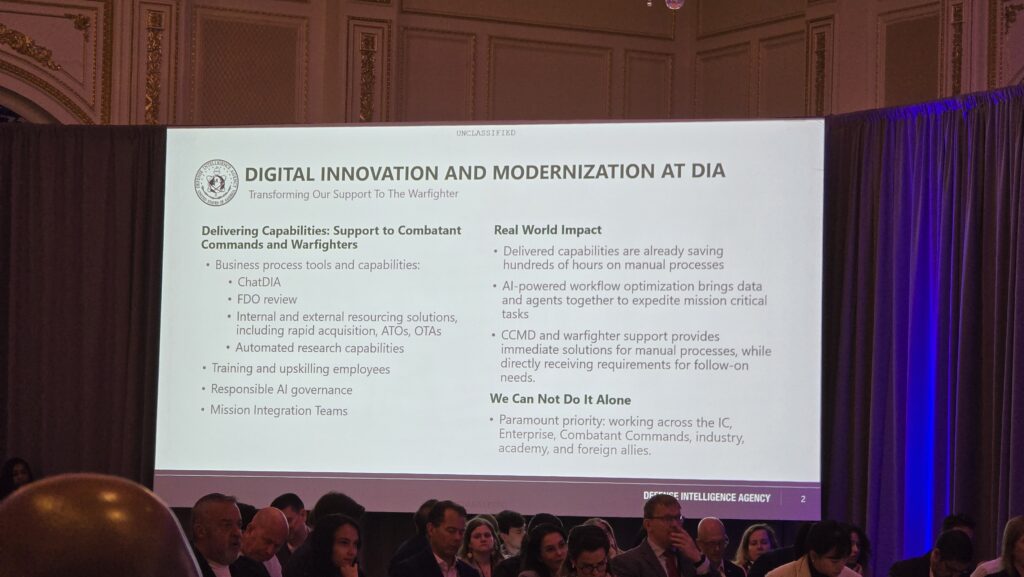
Notable Insights from Major General Robert Kinney
“I want you to move like somebody’s on your heels and they’re about ready to eat you. Seriously.”
“Imagine a day… when an enemy gets inside of our OODA loop. We’re not used to that. We wouldn’t like that. It could happen, but we’re not going to let it happen.”
“The secret sauce for the United States of America, in my opinion, is partnership with academia and industry… the Chinese might have structural advantage… but we have the advantage in research, funding, and ingenuity.”
Breaking the “F-Bomb” (The ATO)
One of the most refreshing takes from the General was his candor regarding the ATO (Authority to Operate). In the Beltway, it’s often referred to with an “F-bomb” prefix because of how long it takes to secure.
To bypass the sclerotic pace of the Federal Acquisition Regulation (FAR), Kinney’s team leveraged Other Transaction Authorities (OTAs). Originally a “Sputnik-moment” tool from the 1950s, OTAs allow the DIA to move at the speed of the private sector. The results? Task Force Saber executed six OTAs in one year, with the final award taking only 40 days.
Delivering the “Kill Chain” of Efficiency
Kinney highlighted three specific wins that move the needle for the warfighter:
- ChatDIA: The first AI Large Language Model (LLM) deployed on Top Secret (JWICS) fabric. Scaled in late 2025, it is already saving analysts hundreds of hours in data synthesis.
- FDO Review (Foreign Disclosure Officer): Using AI to automate the laborious process of scrubbing documents for release to allies (NATO, Five Eyes). By putting a “hungry startup” in competition with established players, they’ve driven costs down and capabilities up.
- Mission Integration Teams (MITs): Deploying three-to-four member teams of data scientists and engineers directly to the field (e.g., INDOPACOM) to flatten workflows and integrate AI into the actual mission “at the edge.”
The Strategic Conclusion
As a technologist, what stands out is the transition from Assisted AI (helping an analyst read faster) to Agentic AI (autonomous agents correlating data across classified fabrics). The DIA is no longer just looking for a “better search engine”; they are building a digital workforce.
Kinney’s “view from the foxhole” is clear: The U.S. wins not through state-mandated civil-military fusion, but through the chaotic, high-speed synergy of a free market partnered with a modernized defense apparatus. The Maverick Accelerator is more than a name, it’s a declaration that the DIA is done with “business as usual.”
For more information, please visit the following:
Website: https://www.josephraczynski.com/
Blog: https://JTConsultingMedia.com/
Podcast: https://techsnippetstoday.buzzsprout.com
LinkedIn: https://www.linkedin.com/in/joerazz/