
CloudLex introduces the first Personal Injury Ecosystem — the complete personal injury management software, built exclusively for plaintiff personal injury law firms. CloudLex is no longer just case management software. It is one connected ecosystem of the Platform, Lexee AI, Paralegal Services, and Voices of PI — the community and content pillar anchored by Trial Lawyers Journal — built so PI firms spend less time managing vendors and more time winning cases.
A typical morning at a mid-size PI law firm might go something like this: check the case management system for deadlines, log into a separate AI tool to review a medical summary, then follow up with an outside vendor to confirm whether records from a treating provider have come in. Three systems, three logins, three places where the same case data lives in slightly different versions. Meanwhile, client phone calls go to voicemail because your intake team is toggling between platforms while trying to log yesterday’s new leads.
That’s not an unusual setup. For most plaintiff PI firms today, it’s the default. Some version of legal software handles matters, documents, and calendars. A standalone AI tool handles medical summaries or intake. An outside service handles record retrieval. Each one does its job. The friction shows up in the spaces between them – and the data management burden of keeping everything synchronized falls on your staff.
Medical records arrive from a vendor and get uploaded to the case management software by hand. Your AI tool generates a summary, but only from the case documents someone exported and uploaded to it – with no visibility into related documents still sitting in another system. A demand letter references treatment dates that have to be cross-checked against a timeline elsewhere. Individually, none of these administrative tasks take long. Across a few hundred active litigation matters, the cumulative time your team spends moving data between disconnected tools starts adding up in ways that are easy to overlook and hard to measure.
One connected ecosystem for personal injury law firms
The CloudLex ecosystem brings platform, Lexee AI, and paralegal services together in a single system of record, so PI firms no longer have to assemble their stack one vendor at a time.
Platform
The system of record covering the full lifecycle from intake through settlement, with PI-specific workflows, medical records tracking, claims management, and settlement management built in.
Lexee AI
AI that reads case files natively, without exports or uploads, to support medical summaries, chronologies, demand drafting, intake capture, and case-specific Q&A.
Paralegal Services
PI specialists who work directly inside the case file to handle medical record retrieval, document management, chronologies, and related support work.
The structural difference lies in how these layers relate to one another. In one connected ecosystem, they share the same data, the same user interface, and the same workflow. Records retrieved by the support team are immediately available for the AI to summarize – no waiting, no re-uploading, real-time access for your entire legal team. Settlement calculations pull from billing data already in the matter. Demand drafts reference treatment chronologies that exist in the same case file where everything else lives.
This is a single system in which each layer operates on the same foundation, making each one more useful than it would be on its own.
What this looks like in a case
Consider a motor vehicle accident case with treatment across four providers over several months.
In a multi-vendor setup, the workflow might move like this: the firm requests records through an outside retrieval service. Records come back by email or portal and get manually uploaded to the case management software. Someone exports the relevant case documents and uploads them to the AI tool. The AI generates a summary based on whatever was uploaded – without pulling from related documents or billing records that may still be sitting in the case management system. An associate reviews the summary, cross-references it against the case timeline, and starts building the demand.
Each handoff between systems is a point where the dataset narrows. The AI only works with what it received. The case management software only reflects what was entered. The record retrieval service only tracks what was requested. Nobody on your legal team has a complete picture unless someone manually assembles one – and that fragmented view of the case files can directly affect the quality of the work product shaping your case outcomes.
In one connected ecosystem, that same case moves differently. The support team retrieves and indexes records directly inside the case file. The AI reads those records natively – full treatment history, billing data, case timeline, all already in the matter. Summaries and chronologies draw from the complete record, not a partial export. When your associate opens the case to draft the demand, the building blocks are already there, in the same place the case lives. No re-entering data, no exporting PDFs to another platform, no checking whether the AI had the latest version of the file.
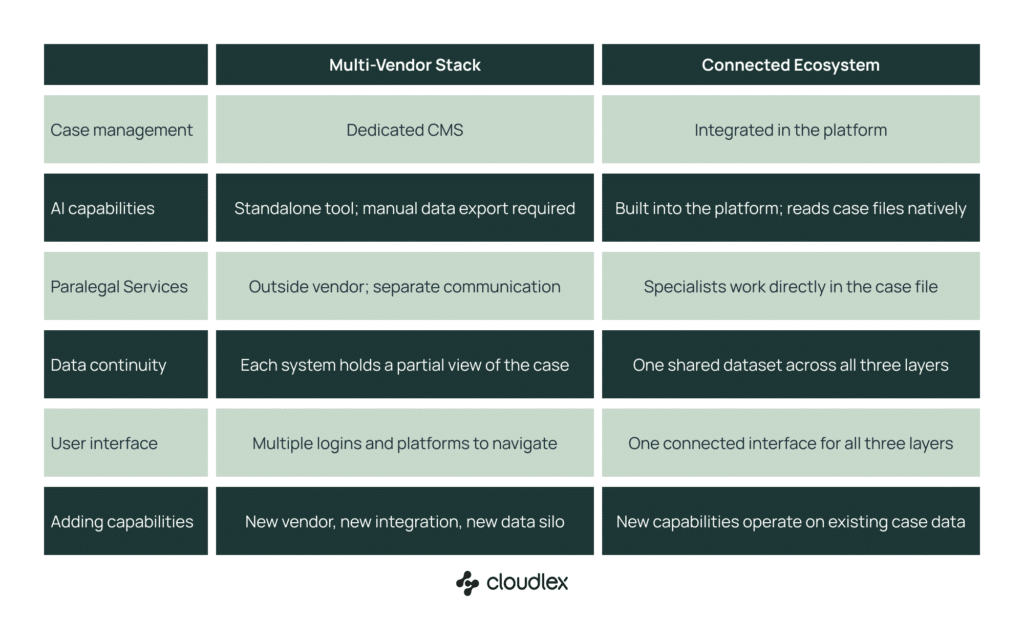
Neither column is inherently right or wrong. Plenty of firms run multi-vendor stacks effectively. But the coordination overhead of keeping data synchronized across systems increases with every tool, and that overhead compounds as case volume grows – particularly for high-volume practices managing hundreds of active claims litigation files simultaneously. A connected ecosystem is increasingly where forward-looking PI firms find an edge — not because the tools they had before were wrong, but because one shared layer for case data, AI, and paralegal support tends to compound advantages the longer a firm runs on it.
Why this is coming up now
Two things are driving this conversation.
First, AI adoption in PI is picking up fast. Firms that were cautious a year or two ago are now actively evaluating tools for medical summaries, chronologies, and demand support. Most of these tools operate outside the case management system, which means the AI is only as current and complete as the last export someone ran. It also means AI-generated output has to be manually moved back into the case file – another handoff for your legal team to manage, another place where something can fall out of sync.
Second, outsourced support services have become standard at most mid-size PI law firms. Medical record retrieval, chronology preparation, document indexing. These services lighten your team’s workload, but they also introduce another data silo. Records come back through a vendor portal or email, then have to be filed into the case management software before anyone else on your team can work with them.
The pattern is familiar: you add tools to solve specific problems, and each new tool adds another system to maintain. Another login, another data format, another place where case information lives outside the system of record. Your stack gets wider without necessarily getting more connected – and the resulting litigation costs, along with the less visible legal costs of duplicated data management and staff time, grow quietly alongside the case count.
A connected ecosystem is the structural alternative. Instead of layering AI and services on top of legal software, it integrates all three into one platform. For firms rethinking their legal operations and looking to establish best practices for how technology, services, and case data connect, the distinction between case management software and an end-to-end connected ecosystem is critical to understand.
What this means for your firm
If your firm has case management software that’s working, the point isn’t to abandon it. But a few questions are worth sitting with:
- How often does the same case data get entered, uploaded, or transferred between systems in a given week?
- When your AI tool generates a summary, is it working from the full case files or just the case documents someone remembered to export?
- How long after records arrive from an outside vendor does your legal team have real-time access in the case management software?
- If a client calls with a question about their case, how many systems does someone on your team need to open to give a complete answer?
Every firm’s answer is different, and the right setup depends on case volume, team size, practice complexity, and appetite for managing vendor relationships. For legal professionals weighing whether to keep building on a multi-vendor stack or consolidate into a connected system, the choice is less about any single tool and more about how your whole operation fits together, and whether your approach to data management is helping or holding back the case outcomes you’re working toward.
CloudLex is the complete personal injury management software — one connected ecosystem of the Platform, Lexee AI, Paralegal Services, and Voices of PI. Each pillar has its own page with more details, and a demo is the most efficient way to see how it comes together on a real case.
Click here to schedule your demo today.