
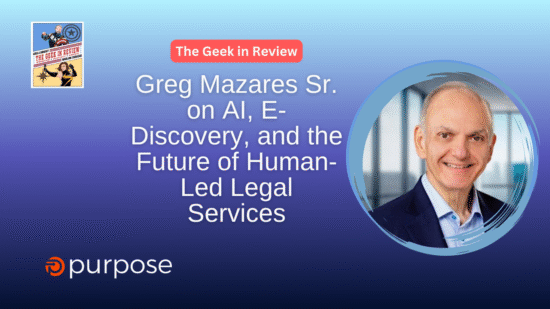
This week on The Geek in Review, we talk with Greg Mazares Sr., CEO of Purpose Legal, about what it takes to lead through one of the most important transition periods in legal services. Drawing on decades of experience across business, litigation support, and e-discovery, Mazares brings a steady, practical view to a market flooded with AI claims and rapid change. His message is clear from the start. The legal industry has faced major shifts before, from paper banker boxes to digital workflows, and this moment is another chapter in that longer story. Rather than treating AI as a threat, he sees it as a tool for adaptation, growth, and smarter client service.
A central theme in the conversation is Mazares’ belief that AI works best when paired with people and disciplined process. He argues that the future does not belong to technology alone, but to organizations that know how to combine tools, talent, and operational rigor. That philosophy sits behind Purpose Legal’s acquisition of Hire Counsel and its broader push to reunite technology and staffing under one roof. In Mazares’ view, clients do not simply want software. They want experienced professionals who know how to apply AI in defensible, repeatable ways that improve outcomes without sacrificing judgment.
The discussion also highlights Purpose Legal’s new offerings, including Purpose Xi and Case Optics, which aim to deliver early case insights in days rather than weeks. What makes Mazares’ framing stand out is his insistence that speed alone is not the point. Faster results matter only when paired with expert validation, tested workflows, and credible guardrails. He describes a legal market where clients once assumed AI would let them bring everything in-house, but now increasingly value outside experts who bring both technological fluency and hard-earned experience. That shift, he suggests, is raising the level of service providers from operational support teams to strategic partners embedded more deeply in legal work.
Greg and Marlene also press Mazares on data security, client trust, and the cultural pressures that come with rapid growth. Here again, his answers return to discipline and execution. He points to major investments in cloud security, around-the-clock protection teams, and tighter controls over on-site review environments. He also argues that many of the greatest risks still come from human behavior, which makes vetting, supervision, and protocol design as important as any technical control. On culture, Mazares emphasizes recognition, communication, and adaptability as the backbone of a company that wants to grow without losing its identity. For him, scaling a business is not only about revenue. It is about building a place where people feel seen, trusted, and prepared for change.
The episode closes on a thoughtful look at the next few years for litigation, junior associates, and the billable hour. Mazares predicts that junior lawyers will not disappear, but their role will shift toward becoming guides in the use of AI, both inside firms and in conversations with clients. As routine work becomes more compressed, he expects associates to provide higher-value service in fewer hours, with stronger technical fluency and a more consultative posture. It is a fitting end to an episode grounded in realism rather than hype. Mazares does not present AI as magic, and he does not dismiss its significance either. Instead, he offers a view of the future shaped by adaptability, experience, and the belief that in legal services, the winning formula still comes down to people, process, and sound judgment.
Listen on mobile platforms: Apple Podcasts | Spotify | YouTube | Substack
[Special Thanks to Legal Technology Hub for their sponsoring this episode.]
Email: geekinreviewpodcast@gmail.com
Music: Jerry David DeCicca
Transcript:
Marlene Gebauer (00:00)
Hey everyone, I’m Marlene from The Geek in Review and I have Sam Moore here from Legal Tech Hub. And Sam, I think you’re going to tell us about AI enablement advisory projects. All right, let’s hear it.
Sam Moore (00:11)
Mm-hmm. Yep, that’s correct.
Thank you, Marlene. So one of the requests that we’ve been seeing quite commonly recently on the advisory side of Legal Tech Hub is what we’re calling AI enablement. This means we’re assessing a law firm or law department’s AI positioning, their readiness, existing use, if any. And we’re seeing this come up in a couple of interesting different ways. Firstly, when a firm is ready to make a commitment and investment into an AI tool or platform,
and they want to make sure they have the best possible experience and see early ROI if they can. They can engage us to run sprints with various teams in the firm to find those early use cases, help refine some workflows, and come up with a roadmap of where to start and where they should be trying to get to. And sometimes those sprints reveal really interesting differences between management perception and attorneys’ actual readiness, which can be really valuable. And the second way we’re seeing this come up
is firms who were early adopters of AI. So maybe they bought into a tool a year ago, 18 months ago, and they’re coming up on renewal. And they’re looking really carefully at the cost and the benefits. And they’ll engage us to run a similar kind of sprint format with a different discovery focus, and we’ll help them surface where that existing tool is and isn’t generating value for the business, help the firm understand why that might be,
and then provide them with the kind of objective understanding needed to really inform that go, no-go decision on renewal. And those subscriptions can be quite big numbers. So being confident in the renewal decision is really important. And we’re finding that those AI enablement projects often lead into further work around AI procurement, which I think is a really encouraging sign that the industry is moving beyond the FOMO and the push to buy something now and
figure out how to use it later. And instead, I think we’re now taking a more nuanced and measured approach that goes beyond the hype, and that could only be a good thing.
Marlene Gebauer (02:14)
It sounds like a really important advisory service that you’re offering because it’s really important to kind of have a third party give an impartial review and an opinion on this. So, sounds great.
Sam Moore (02:29)
Fantastic. Thank you.
Marlene Gebauer (02:37)
Welcome to The Geek in Review, the podcast focused on innovative and creative ideas in the legal industry. I’m Marlene Gebauer.
Greg Lambert (02:44)
I’m Greg Lambert. Marlene, you know, we’ve brought in a bunch of the new kids on the block recently with all the legal tech, but the new kids are not old enough to know the New Kids. So, today we’re going to bring on a veteran who has successfully navigated the industry in the era all the way back when we were
Marlene Gebauer (02:53)
I hope the new kids actually know that reference.
That’s all right.
Greg Lambert (03:08)
pulling up all those paper banker boxes all the way to the current generative AI phase.
Marlene Gebauer (03:11)
Mm-hmm.
We’re thrilled to welcome Greg Mazares, Sr., the CEO of Purpose Legal.
Greg is a Harvard MBA and has over 45 years of executive experience building and scaling companies in consumer products, financial services, and litigation support.
Greg Lambert (03:32)
And Greg’s an executive who likes to describe himself as a student of the game who has applied classic strategic frameworks to the evolution of e-discovery. So Greg, welcome to The Geek in Review.
Greg Mazares (03:44)
Thank you. It’s great to be with you both.
Marlene Gebauer (03:47)
So Greg, you have a unique daily routine. We’ve heard that you start every morning with an hour of research. So, reading everything from legal tech news to McKinsey white papers while keeping Michael Porter’s Five Forces top of mind. So in an industry that often feels like it’s reinventing itself every six months,
Greg Lambert (04:00)
Wow.
Marlene Gebauer (04:07)
how does grounded historical study and classic economic theory help you cut through AI hype and identify real strategic opportunities?
Greg Mazares (04:16)
I would say that the most important thing to me is not to be afraid or concerned about change. And I read looking for ways to adapt, looking for ways other people are adapting,
and trying to see where trends are going as opposed to looking for reasons to get out of doing the things that have helped us be successful through the years. I’ve been thinking about AI quite a bit. I remember back when I started my career at a Carnation company, a subsidiary of Nestlé, we had six members of the team who were working on what I would call entry-level typewriters. And then suddenly one of the senior
executives decided to bring in a very large IBM Selectric, you know, the newest piece of great technology. And they cut six people down to one person to support the entire marketing department at that point in time. But the other thing I learned is that the other five people, rather than eliminating them, they were redeployed in other roles. And so I look at that and then we jump to what has transpired in
where we started, you talked about banker boxes and paper and people. It was amazing. We’d run into each other crossing the street, you know, which boxes were going to collide with other boxes, so forth, so on. We moved from that into technology, TIFF images, all of the above. And once again, we had to adapt and we had to change. And so when I’m looking at, in the case of AI, I see AI as an amazing opportunity,
not a problem. And all of the people who have predicted doom and gloom for our industry, I just don’t agree with that. I think there are strategic ways to embrace AI and embrace the AI age and help our clients in ways we’ve never been able to do so before. So I read everything that I can, but I’m somewhat focused. I also
look at what the competition’s doing. I look at other industries and how they’re applying AI. It’s not just about the legal industry. It’s about general management more broadly. And I think there are great opportunities right now. I’m as excited today as I was when I started in the legal field in 1988. And I think it’s just a new age for us all.
Greg Lambert (06:50)
Well, speaking of Carnation, it reminded me my uncle was a Carnation delivery driver for like 30 years in Arizona. So I’ve got some family ties there as well. Well, Greg, it sounds like you’re like us, you’re a lifelong learner. You’re constantly trying to look at new information, but not chase the trend. But one of the things that you did in early 2026
is Purpose Legal acquired Hire Counsel, which brought a network of, I think it was over 70,000 vetted attorneys into the fold. And you described this as an inflection point where technology providers and staffing firms have moved too far apart. So why is it that you feel like the market needed to bring back in a people layer and the technology layer and put those back
together under one roof? And what does the modern legal services provider look like now that these two layers are unified?
Greg Mazares (07:55)
I think the most important thing is the realization that AI by itself, it’s not all about the technology. The age of AI is about technology, people, and process. And probably process working in conjunction with great people
is going to turn out to be the most important aspect of AI. That’s because we have those that have totally embraced it, and we have those that are on the other end of the spectrum that are fearful of it. And then we have some that are dabbling in it. They’re not sure which way to go just yet. But I think the combination of great people working with and implementing impeccable processes using AI, that’s going to be the winning formula for everybody going forward.
Greg Lambert (08:44)
How do you spin it so, because a lot of us talk about thinking in a workflow where AI first, where you think of what is it that the tools, the automation, can do for you to get you to the starting point, a little further along from where your starting point is. How is it that, how do you explain this to the people on how to
integrate the AI tools or automation tools or the process into their workflow in a way that makes sense for them?
Greg Mazares (09:17)
First and foremost, I think we need to look at are there tasks that are relatively simple and easy and almost machine-like that AI can replace for people? Can we free people’s time to work on higher level tasks and higher level work product, et cetera? So one of the ways that AI can be incorporated is in things that the clients see.
Another way is the things that clients don’t see that we have to do each and every day. If we can free up some of the tasks, many of the tasks that we do when we’re working on our own,
in order to create time that we can spend in helping our clients, helping our colleagues, et cetera, at a higher level, then I think the use of AI is really important in any business, any organization at any time. So it’s not AI or people, it’s AI plus people,
utilizing great process that I think is going to carry the day.
Marlene Gebauer (10:30)
So I’m going to add one more pillar to your people, process, tech. I’m going to throw in knowledge. And I want to preface the question by noting that today Harvey announced that they basically have an agentic workflow now incorporated into their product. It’s like from start to finish, you tell it what you want to do. You tell it what the result is. And it will do it now.
Greg Lambert (10:48)
Everybody’s got an agentic workflow now.
Marlene Gebauer (10:59)
I haven’t seen this yet, but you’ve introduced a concept called engineered intelligence, which powers your new Purpose XI. Is that how you… Purpose…
Greg Mazares (11:08)
Purpose XI,
and then one of the modules of that that we have introduced up front is Case Optics.
Marlene Gebauer (11:18)
Okay, so if I’m understanding this correctly, this codifies a human intelligence plus AI philosophy. So it rejects the idea of AI as a standalone substitute for human judgment. So with the launch of Purpose XI and Case Optics, you’re promising early case insights in days rather than weeks, which is great. How do you practically ensure that speed doesn’t compromise defensibility,
and why is this expert validation an essential guardrail for today’s litigation?
Greg Mazares (11:49)
That’s a great point. I think if it were technology by itself and we’re talking about speed, that’s one thing. If we’re talking about speed using amazing technology, and there are so many choices when we’re talking about AI, I think we’d all agree there’s not one solution. There’s a myriad that are out there and there are many that are very, very good. But when you have people that have had experience and understand how to use the technology
to incorporate excellent judgment into what we’re doing, then that is another layer of value that we’re adding to clients. So clients used to hire us and other companies
because of the people and their belief in the people. Now we have people that can be supercharged with the help of new technologies. And these experts are able to develop workflows that are tested, that are true, that are defensible in nature, that reduce risk. And the combination of the two is so powerful. And we now have many clients that say to us, we thought
that when AI came out, we weren’t going to need you anymore after a certain point in time. You would teach us and then we could just go off and we could do it all by ourselves in-house. Now they’re saying, we think it’s going to be a long time, if not forever, that we’re going to need to work with people like you because you add a layer of experience, judgment, and you give us the guardrails and the
defensibility that we need to be even more efficient and effective in the work that we do. So we’re viewing it now as a partnership in which we work with our clients. Our people, who are very experienced, have worked on multiple projects, have made mistakes, have learned from the mistakes, have avoided mistakes, because people will always, using judgment, they will
refine what they do over time. The fact of the matter is the clients have more confidence in having experts who can basically elevate their game using this very powerful technology. They are more confident working as a team. So in effect, it’s elevated the kind of work that we’re doing. We’ve created new services and we have people that are doing new and different and better things that are helping
our clients in such a way, it’s giving them even more confidence in the technology than if they were off on their own trying to utilize it. And don’t get me wrong, there are brilliant clients everywhere you look, but they like to have another expert add a layer of confidence. When I talk about defensibility and we talk about guardrails, we’re talking about
clients who want to use the technology, but want to also know that they’re not going to be criticized. They’re not going to make a fatal mistake and that they can use it over and over and over again in newer and better ways as they gain experience. So it is something that’s going to take some time. I would call it an evolution rather than a revolution. And everybody’s learning as we go along.
In some cases, it’s being adopted very quickly. In other cases, there’s a level of hesitancy to go all in. And for this reason, I would suggest that our industry has changed, but it’s not changing all at one time. It’s something that’s going to happen over many years. And it will be different for some versus others. So we’re excited. We look at it as a great opportunity to have our many
talented, experienced, proven people be able to help our clients advance their practices in ways that they haven’t experienced before.
Marlene Gebauer (16:03)
Yeah, so all of us are smarter than one of us, right?
Greg Lambert (16:03)
Greg, I…
And just to follow up on that, Greg, I think, you know, and I’ve seen it with our vendor partners, that it used to be, you’d be like set this up, get us ready to go, train us, and then turn us loose. And then we might have monthly or quarterly follow-ups on it. But now I’m seeing almost weekly, daily, almost interactions with our
Greg Mazares (16:08)
I think.
Greg Lambert (16:34)
vendor partners on this. Are you seeing that there’s a much tighter relationship between you and your customer clients, and how are your people kind of adjusting to that? Because it’s got to be a little bit of a different workflow over the past couple of years now.
Greg Mazares (16:52)
It is, and it’s a different feeling and a different role. Right now, a lot of our people who are the experts in AI, such as our CIO, who heads up this whole area for us, his name is
Jeff Johnson, he’s based out of Dallas and he does an amazing job. Jeff is actually viewed as an extension of the law firm team. And they almost view it as they don’t want to go to war without having this type of expertise working with them. So we love this, it’s elevated everyone’s game. We’re probably doing less of the more elementary work
that we might have done in the past, and we’re doing some higher level consulting work right now. We have an advisory group that works with clients depending upon their specific needs in a lot of different areas. So what I’m really talking about is this is part of the opportunity. Instead of doing lots and lots of elementary work, we’re now doing quite a bit, if not the same quantity, of higher level work. And so we, like everybody
else, have to adapt to providing services and making money in different ways. And it’s exciting, scary, exciting, all of the above. But boy, it gets you motivated to get up each day and find ways to do a great job on behalf of our clients and on behalf of our people. If we take care of our people and we take care of our clients, we will continue to build a winning organization.
Greg Lambert (18:27)
Well, not to throw a wet towel on the conversation here, but we got to talk about data security and all the fun stuff that comes along with it. So we’re in this era now of a post-zero trust environment. So,
what are you doing and how is Purpose Legal re-engineering the discovery process to ensure that the data sovereignty is there while still allowing for this massive scale required for things like the HSR second request, things like that, that you and your customers run into with security issues?
Greg Mazares (19:11)
Well, one of the things that’s changed versus years past, and what you’re bringing up is such an important point and a great question,
is that so much of the data, of course, is now stored in the cloud as opposed to on-premise. Big, big change. We’re working with organizations such as Relativity, Everlaw, 4iG, I can go on and on and on, who have with us set up security mechanisms that are actually better than they have been before.
We have invested heavily in putting together a large technology group that works around the clock. We have people both in the US and outside who are employees, have been part of our team, to help us protect the data. We also want to make sure that
we basically haven’t seen, we’ve seen attempts as everybody will see, at security breaches. We have been able to work hard by setting up mechanisms in advance that will prevent penetration, for example. So we spend a lot of money on data security because clients need to go to sleep at night knowing 100 percent. I mean, it’s not a 50 percent chance.
It’s 100 percent. They need to know that we’re doing everything we can to protect data. But again, I make the point that so much of the data these days is stored in the cloud. Much of the data is also stored on client systems in certain cases where clients have invested in their own instances for data storage. So data is absolutely moving away from on-premise to cloud environments that are highly protected,
both by the provider as well as by a large team of security experts in our company. It’s the nut without which you have to have security so that your clients go to sleep at night knowing that there’s not going to be a problem with data.
Greg Lambert (21:16)
Greg, I’m going to hit you with a hard follow-up here. What are some security issues that you think people may be over concerned about? And then what’s something that you think they’re under concerned about right now?
Greg Mazares (21:29)
Well, I think they’re over concerned about
a data breach of the corpus of data that we may be reviewing on their behalf in some instances. I think that what they need to be concerned about, I’ll give an example. I’m aware of a situation where document reviewers were using 3D glasses in order to try to capture data, look at data, so forth. They’re using technologies.
This wasn’t within our company, but it’s something I’ve heard within the industry. We are now making sure that any on-site reviews are first and foremost secure. So we do not allow reviewers to bring in anything but the clothing they’re wearing, so to speak, maybe traditional reading glasses, et cetera, contact lenses. But bottom line is there are
Marlene Gebauer (22:23)
I
Greg Mazares (22:23)
Thank
Marlene Gebauer (22:23)
hope you let them wear their glasses. It’s like if it were me, I’d never be able to read anything.
Greg Lambert (22:23)
I was actually thinking,
I would say the little red and blue, yeah,
the red and blue 3D glasses that you wear at a movie theater.
Marlene Gebauer (22:32)
You
Greg Mazares (22:33)
It’s unreal. There are things that people bring in with them and again, we just outlaw it. You just can’t have any of that. So we have to protect the clients because there are still a number of on-site reviews where we have lots of people in a room. Frankly, you have to protect against this
on the outside as well. So the bottom line is those are the things that we feel there’s greater risk because there are a lot of people that you don’t have direct control over as we did in the old days where we would have supervisors in a single room with anywhere from 10, 50, 100 people reviewing documents at one time. So this has to be impeccable. That’s an example that I would throw out there.
Marlene Gebauer (23:23)
Yeah, it’s interesting because everything I read, the main risk is human error as opposed to the technology failing or something like that. Would you agree with that?
Greg Mazares (23:35)
Well, I think you can always have technology failure. I think people, first and foremost, you need to make sure that you vet reviewers properly. You need to have multiple layers of vetting. We do have certain criteria where we won’t use certain people. We many times will reject
many more people on projects than we will accept. They’re just not the right people, don’t have the right level of experience or the track record. And this is why we bought a company with, I’ll call it a small army of experienced people that’s been in operation for multiple decades. We can be very selective of the right people for the right project to make sure that we give clients exactly what they need, both in terms of skills, experience, expertise,
and a track record of doing things the right way. So beyond that, I can tell you a lot of money goes into data security systems and the people that safeguard it day in, day out. Once again, clients keep coming back because they know their data is going to be in good hands and it’s going to be taken care of the way it should be. There’s no shortcuts.
We need to be unbelievably stringent in data security and in protocols and in processes. And if you do that and you keep doing great work, clients will keep coming back. And that’s not something they will worry about anymore, but they should worry about it. We all need to be worried about it because there’s a lot of smart, bad people out there too, as we know.
Marlene Gebauer (25:13)
Exactly. All right, I want to switch the conversation a little bit to sort of institutional growth and its impact on culture. So Purpose Legal has seen a 500 percent growth in recent years and is a multi-time Inc. 5000 honoree and backed by Blue Sage Capital. And in fact, Blue Sage has said that they partner with
management that they like, trust, and admire. So congratulations. But as you scale through aggressive M&A, I mean, that’s challenging from a financial perspective, but it’s also challenging from a culture perspective. That certainly has an impact on the organization from a cultural perspective and a human perspective. How do you maintain
a human-centered culture and still stay that company of choice, both for elite legal talent and sophisticated clients?
Greg Mazares (26:08)
No, it’s a great question, especially in the current economic environment, world environment, the impact of AI, which is worrying a lot of people about their future, rightly so.
In some cases, maybe not. Maybe it opens up opportunities too. I guess that’s the way you look at it. First of all, let me make the point. While we’re many times larger than we were, let’s say, three years ago, most of it has been organic growth. We haven’t purchased a lot of companies. And we were very selective and strategic, I think, in the acquisition of Hire Counsel.
Why did we do that? And I want to just start there. Why did some people say it’s counterintuitive? Because if AI is coming onto the scene, why are you acquiring a company that is heavy, heavy, heavy people-oriented? And the fact of the matter is,
we saw early on that while AI is amazingly powerful, you’ve got to have great people behind the wheel of AI. That’s number one. Number two, not all document review projects are going to utilize AI. And so you will have to have people. There’s going to be buckets. You’re going to have AI all in, AI partly in, and no AI. It’s going to be that way, I think,
for a few years, although it is speeding up where some level of AI is being incorporated in the process, which it should be. I think it should be across the board. But I’ve learned enough to know that not everybody jumps on the bandwagon at the same time. There are early adopters and there are those that want to wait and see. So in looking at M&A as an opportunity,
we thought this particular acquisition was going to help us cover all of the constituencies in this emerging AI environment. And so we can handle projects that involve very few people because the technology can do lots of the work. We can handle the midsize projects and then we can put hundreds of people onto a single project who are all experienced, vetted,
and people we can rely on. We want to be able to handle the different constituencies and different requirements that are out there that I think will be there for many, many years to come. Our growth is about the people that we have becoming more and more productive. The reason we like AI is because we want to make our people more capable of doing more and better
work faster and be able to be repetitive and do great things for our clients over and over again. So it’s going to take the combination of great technology plus great experienced people. And we’re still developing the experience levels with people because that’s where the training comes into play. And then the other thing is processes. I know that we all didn’t invent people, process, technology.
But in the case of AI, I can’t stress enough, process, process, process, driven by really good people and using one of several choices for great technology. That’s going to carry the day. It won’t be technology alone. It won’t be process alone. It’s the combination, the three-legged stool, that is going to be so critical to the long-term success of companies
in this industry. And as I mentioned earlier, we all have to look at ways on our side of the equation, we have to look at different ways to help our clients and to earn a fair profit. Because we’re not just hosting terabytes and terabytes of data anymore. As you know, companies like Relativity and Everlaw and others, they’re handling that, or firms are making commitments on their own. Law firms are smart. They’re making
good business decisions on their own to invest in technology to host their own data. So through a combination of consulting, a combination of the work that we do on core competencies like forensics and analytics, having very smart people to work on what I’ll call science projects, for lack of a better term, where people haven’t seen certain types of data or how to utilize
it or how to analyze it or how to store it, et cetera, we’re able to add value on some of the hard things about our industry that I think makes us unique. And so we’re building the business through repeat clients who start off giving us smaller projects to midsize projects to mega projects to managed services agreements. And that’s how we’re building the business. Will we look at other M&A opportunities?
Yes, we will look at everything, but we’re going to be extremely selective as we move forward. And so I really do think it’s going to be more organic growth and finding different ways to help our clients and to keep growing our people that’s going to help us build the business first and foremost.
Greg Lambert (31:35)
Greg, before we get to our crystal ball question, since you’re a lifelong learner, I’m interested to hear this. What are one or two kind of must-read, must-listen, must-watch things that you use that you think other people would
Marlene Gebauer (31:40)
I’m very interested to hear what this is going to be.
Greg Lambert (31:53)
be beneficial for them to watch or listen to?
Greg Mazares (31:57)
Well, first and foremost, to start out, this may sound really simple, I would do a whole bunch of setup and a whole bunch of Google Alerts on various topics. And I’m getting information throughout the day. Now I’m going to convert my Google Alerts into an AI deliverable because I can get an assessment each day of what’s happening in the industry, et cetera, et cetera. That’s kind of baseline types of things.
But believe it or not, you find things and you see things and you learn things pretty fast if you take the time to think about what categories of information would you like to capture. I read JD Supra every day. I think there are a lot of great articles. I read most of the legal trade publications. I read a lot of books such as,
right on my desk right now. I’m reading Measure What Matters by John Doerr. I’m reading Pattern Breakers. I’m looking at where things are headed two or three years out, if not beyond. I don’t think anybody can predict what’s going to happen 10 years from now.
Greg Lambert (33:11)
Hold that thought because we’re about to ask you that.
Marlene Gebauer (33:13)
Hahaha!
Greg Mazares (33:17)
But I think the most important thing is to try not to become complacent, thinking that after 10, 20, 30, 40 years in an industry that you know everything there is to know. I learn so much every day. I make mistakes every day. I also make some good decisions every day.
The bottom line is I think there are books we can read. I think having conversations with people in the industry that we trust is a great way to learn. Talking to competitors, I call them cooperative competitors.
Greg Lambert (33:59)
Yeah.
Greg Mazares (34:00)
Talk to competitors and see if there’s a common theme in what people are thinking and saying is smart. I think on the law firm side, I’m sure you do that all the time with people in other law firms or corporate clients, et cetera. There are so many smart people out there that we can learn from. And so I make it a point every day to read, to have discussions, to talk to my colleagues internally,
people in our company that can run circles around me on a whole bunch of topics. And then they come to me on things where they think I might be able to add some value. The last thing I’m going to focus on is always spending a lot of time each day communicating with people. Recognize their anniversaries, recognize their birthdays, know about what’s going on in their families. Let them know how much you appreciate
what they’re doing. Catch them doing things right is a term that we use all the time. And we’re actually setting up a committee that each month will recognize wonderful things that people have done, both in the business, in their community, helping each other, et cetera. So that’s a roundabout way of saying, I wish I could tell you it’s one thing. There’s a whole bunch of things we do in order to help
build a solid, solid company that will have a long runway, I hope, long after I’m no longer involved with it.
Marlene Gebauer (35:32)
So Greg, as Greg mentioned, we do have our crystal ball question. So this is where we ask you to predict the future. So looking ahead over the next three to five years as the engineered intelligence model matures, what do you think is the single biggest shift you see coming for the traditional role of a junior associate and the billable hour in litigation?
Greg Mazares (35:57)
It’s a great and obvious question because clients are not going to want to pay for hundreds and thousands of hours of work that could be done in tens of hours, let’s say. And so I think that junior associates are going to become, in my opinion, the ambassadors on how to use AI. They’re going to be able to use AI in ways that they haven’t before to teach their clients, to help their clients. They’re going to elevate the game. I think junior associates are going to become consultants at high levels for clients. They’re going to have to learn. The key thing is to make sure they
still learn enough. And I’m not a lawyer, although sometimes I feel I should be after almost four decades in the industry, but I’m not, so I’ll preface. But I think junior associates got so much training from reviewing documents and understanding what the documents contain and the different types of information and issues and so forth. I think they’re now going to have to not only get a grounding in the law, obviously,
but they’re going to have to now elevate to becoming experts in the use and application of new technology so that they can better help their clients. They may become the teachers to senior partners in some ways. They may come in with more knowledge into the firm than some of their elders have. And they may become incredibly helpful in that
regard. They will also learn. They can also teach and help their corporate clients in some ways. So I think what’s going to happen is they will bill hours, but they will probably bill hours for different levels of services at lower levels of hours, but at higher rates in some cases, in many cases. It’s going to have to work that way because there will be a trade-off. But I don’t see, there may not
be quite as many junior associates, but those that there are, it’s going to be like having two or three people because they’re going to be able to use amazing personal knowledge coupled with very powerful technology. And it’s almost like taking one person and turning that one person into two or three that will help carry the day. But I don’t think that all junior associates or the role of the junior associate is going to go.
It’s just going to change, and I come back to adaptability. So we all need to change and if we do, as we have over many decades, we can flourish.
Greg Lambert (38:47)
Greg Mazares, Sr., CEO of Purpose Legal. Thank you very much for joining us and sharing your daily routine and your knowledge with us. This has been a fun conversation. Thanks.
Marlene Gebauer (39:00)
Thank
Greg Mazares (39:01)
Thank you both.
Marlene Gebauer (39:03)
And thanks to all of you for listening to The Geek in Review podcast. If you enjoyed the show, please share it with a colleague. We’d love to hear from you on LinkedIn and our Substack page.
Greg Lambert (39:13)
And Greg, for listeners who want to follow the Mazares method, as we’re going to call it, or learn more about your company or Purpose XI, what’s the best place for them to find out more?
Greg Mazares (39:27)
Certainly contact me on LinkedIn or also go to our website, www.purposelegal.io, and send a message there. I would certainly love to connect with anyone who would like to chat or communicate online.
Marlene Gebauer (39:42)
As always, the music here is from Jerry David DeCicca. Thank you, Jerry. And bye, everybody.