
The Big Takeaways
- Most billing cycle delays stem from process gaps at four key stages: time capture, pre-bill review, invoice delivery, and payment collection, and each one has a concrete fix.
- Legal billing automation and centralized time tracking eliminate the manual handoffs that silently add weeks to the gap between work performed and revenue collected.
- Firms that connect every billing stage in a single platform compress their collection cycle, improve cash flow, and reduce write-offs without adding administrative overhead.
In a typical law firm billing cycle, an attorney:
- Finishes work on a matter
- Enters billable time when they have a free moment
- Waits for a pre-bill review, invoice approval, and for clients to pay
Each handoff introduces delays that, when multiplied across dozens or hundreds of active matters, could mean the firm is financing its clients’ legal work interest-free for 60, 90, or even 120 days.
Most of the delays are easy fixes as they stem from process gaps in manual workflows. Identifying where bottlenecks occur in the law firm invoicing process and applying legal billing automation at each stage enables firms to compress the time between work performed and cash received without adding administrative overhead.
Where Bottlenecks Hide in the Billing Cycle
The billing cycle has four distinct stages, and each one has its own friction points. Recognizing where your firm loses time is the first step toward fixing it.
Time and Expense Capture
Delayed time entry is a leading driver of billing cycle slowdowns. Attorneys who rely on paper timesheets or spreadsheet trackers routinely experience missing billable hours, billing delays, and lost revenue. And the longer entries sit unrecorded, the worse it gets.
The sooner you bill fees and costs, the greater the probability of collecting them, while time that ages beyond a certain threshold becomes practically uncollectable.
When attorneys reconstruct hours, days, or weeks after the fact, the downstream effects include:
- Entries that take longer to create because the attorney is working from memory rather than from a real-time context
- Less accurate, less detailed descriptions that lead to write-downs during review or disputes after the invoice arrives
- A cascading delay on everything that follows, since pre-bills cannot be generated until time is entered
Expense capture introduces similar problems. Costs that are not recorded promptly get forgotten entirely or require manual reconciliation later, both of which stall the process.
Pre-Bill Review and Edits
Once time and expenses are entered, a billing attorney or partner typically reviews pre-bills before they become client-facing invoices. At many firms, this stage is where momentum stalls.
Common slowdowns include:
- Paper-based markups. Pre-bills are printed, annotated by hand, and routed back to the billing staff for manual corrections. A single round of revisions can take several days.
- Unclear ownership. It’s unclear which matters are ready for review, which are sitting on a partner’s desk, or which need a second pass after edits.
- Batch processing habits. Some billing attorneys let pre-bills accumulate for weeks and then review everything at once, creating a bottleneck that delays all matters equally.
The pre-bill review stage often accounts for more wasted days in the billing cycle than any other, yet it receives the least attention during process improvement efforts.
Invoice Generation and Delivery
Even after a pre-bill is approved, converting it into a final invoice and getting it to the client introduces additional lag. Firms that rely on manual formatting, PDF creation, and email or postal delivery often add another week or more to the cycle.
Several patterns make this worse:
- Inconsistent billing schedules. A firm that bills monthly but does not actually generate invoices until the 15th or 20th of the following month has already built in a two- to three-week delay before the client even sees the bill.
- Manual formatting and delivery. Creating individual PDFs, attaching them to emails, or printing and mailing paper invoices adds time to every single bill.
- Invoice errors. Mistakes that require re-issuing an invoice reset the clock entirely, adding days or weeks before the client receives a corrected version.
Payment Collection
The final stage of the billing cycle depends on how easy (or difficult) the firm makes it for clients to pay. Common friction points include:
- Limited payment options. Firms that accept only checks or require clients to call in payment information create unnecessary barriers to prompt payment.
- No scheduled follow-up. Without reminders, outstanding invoices often sit untouched until someone at the firm remembers to reach out. By that point, the client may have deprioritized the payment.
- An adversarial collection dynamic. When follow-up is manual and inconsistent, the collection process starts to feel confrontational rather than routine, straining the client relationship.
How to Eliminate Bottlenecks and Accelerate Every Stage
The most effective approach to addressing bottlenecks throughout the billing process is having one connected workflow rather than relying on four isolated solutions. This workflow should offer:
Centralized, Real-Time Time Tracking
The fastest way to compress the billing cycle is to eliminate the gap between performing work and recording it. With legal time tracking software built into your practice management platform, attorneys can capture time as work happens rather than reconstructing it later.
CARET Legal offers multiple ways to capture time, including one-click timers that follow users across tasks and devices, automatic time entries generated from calendar events, emails, and phone calls, and the ability to convert activities directly into billable entries. When time entry becomes a background function rather than a separate administrative task, firms recover more billable hours and keep entries flowing into the pre-bill queue without delays.
For firms looking to go further, passive timekeeping tracks attorney activity automatically and logs time without requiring manual input. The result is a more complete picture of billable work with minimal effort from the timekeeper.

Streamlined Pre-Bill Review
Digitizing the pre-bill review process removes the biggest source of dead time in most billing cycles. Instead of printing, marking up, and manually routing pre-bills, billing attorneys can review and edit draft invoices on-screen, approve them in a few clicks, and move them to the invoice queue immediately.
CARET Legal’s pre-billing feature gives firms full control over invoices before they reach clients. Draft invoices display all captured time and expenses, and reviewers can make edits, adjust descriptions, and approve or reject entries within the platform. Because everything lives in one system, there is no waiting for paper to move between desks or for staff to re-enter handwritten corrections.
When firm administrators can see which matters have pending pre-bills, who is responsible for review, and how long invoices have been waiting for approval, accountability improves. Review cycles that previously took a week or more can shrink to a day or two.
Automated Invoice Generation and Delivery
Once a pre-bill is approved, the invoice should go out immediately. Legal billing automation makes that possible by converting approved pre-bills into finalized, professional invoices without manual formatting steps.
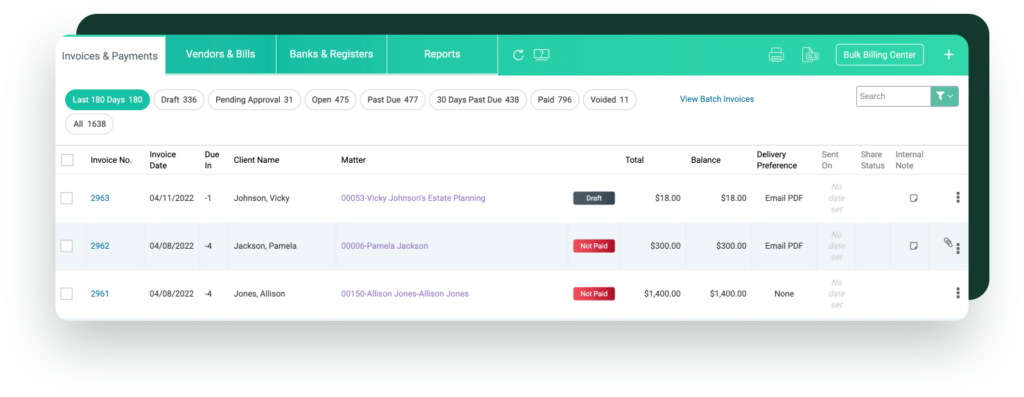
CARET Legal’s bulk billing center processes multiple invoices in a single action, which is particularly valuable for firms handling high volumes of matters. Invoices can be customized by client or practice area, formatted to meet LEDES or other e-billing standards, and delivered electronically through the platform’s secure client portal.
The shift from manual to automated invoicing does more than save time on individual bills. It enables firms to enforce consistent billing schedules, such as sending all invoices within the first five business days of each month, and to track whether clients have viewed their invoices after delivery.

Integrated Online Payments
The fastest invoice in the world does not help if the client faces friction when trying to pay. Integrated payment processing closes the loop by making it simple for clients to settle balances the moment they receive a bill.
With CARET Pay, clients can pay directly from their invoice using embedded PayNow links. The system accepts credit card, ACH, and eCheck payments, and all transactions are automatically reconciled with the correct client and matter record. There is no need for separate payment platforms, manual data entry, or trips to the bank to deposit checks.
A client-facing portal gives clients self-service access to view and pay their invoices, reducing back-and-forth with firm staff. The firm collects faster, and the client experience improves at the same time.
One Platform, Zero Handoffs
These improvements deliver the most value when they work together in a single system rather than across disconnected tools. When time entry, pre-bill review, invoicing, and payments all operate within the same legal practice management software, there are no exports, imports, or manual data transfers between stages.
A time entry becomes a pre-bill, a pre-bill becomes an invoice, and an invoice becomes a payment, all within CARET Legal.
This connected workflow also gives firm leadership real-time visibility into billing cycle metrics, accounts receivable aging, and financial performance across the practice. When you can see exactly where matters are stalling in the billing pipeline, you can address delays before they affect cash flow.
Remove Bottlenecks for Your Billing Cycle
A shorter billing cycle compounds over time. Invoices that go out a week sooner get paid a week sooner. Multiply that across every active matter, and the impact on monthly cash flow is substantial.
More importantly, prompt and accurate billing reinforces client confidence. Clients who receive clear, timely invoices are more likely to pay without dispute and more likely to view the firm as organized and professional. Slow, error-filled billing signals the opposite, regardless of the quality of the legal work behind it.
The firms that tighten their billing cycles are not necessarily working harder. They are removing the manual steps, disconnected tools, and process gaps that slow everyone down. Legal billing automation handles the repetitive work. Centralized time tracking keeps entries flowing. Digital pre-bill review eliminates paper delays. Integrated payments remove the last barrier between invoice and collection.
If your firm is ready to close the gap between work performed and revenue collected, schedule a demo of CARET Legal and see how a unified platform can streamline every stage of your law firm billing cycle.
The post How to Shorten the Law Firm Billing Cycle and Get Paid Faster appeared first on CARET Legal.